
A program director gives two weeks’ notice. Your office manager follows a month later. Both say “it’s just time for a change.” Then a third person resigns and mentions, on the way out, that she stopped bringing concerns to her supervisor a year ago. By then you have lost three people, and you are hearing the real story for the first time.
A good exit interview process is a short, consistent conversation with every departing employee, run by someone neutral, documented the same way each time, and followed by a decision about what you will do with what you heard. Here is how to build one without an HR department.
TL;DR
- Offer an exit interview to everyone who leaves, voluntarily or not, using the same core questions each time.
- Choose a neutral interviewer. A direct supervisor is usually the wrong person.
- Treat it as both a culture check and a last chance to hear about harassment, discrimination, wage problems or retaliation, and respond quickly if you do.
- Participation is voluntary. Never pressure anyone or tie it to final pay or a severance release.
- Decide before you start who reads the results and what happens next. Feedback nobody acts on costs you trust.
Table of Contents
- Diagnose before you design
- The exit interview process, step by step
- What to ask: a usable script
- What an exit interview form should include
- What California adds
- Perspective: the interview is a mirror, not a verdict
- Follow up so people see something change
- Where we can help
- FAQ
- Sources
Diagnose before you design
Before you write a single question, ask what you are trying to learn. In our work with small organizations we use a simple triage, our People Problem Triage™, that separates what looks like one problem into its real parts: performance, conduct, culture, management, process, documentation and legal risk.
Applied to departures, it looks like this:
| Factor | What you listen for |
|---|---|
| Performance | Unclear expectations, no feedback, a role that changed without anyone saying so |
| Conduct | Named behavior: yelling, favoritism, jokes, exclusion |
| Culture | “Nobody says anything here” or “we don’t talk about that” |
| Management | Whether the supervisor is fair, responsive, and trusted with concerns |
| Process | Scheduling, workload, onboarding, pay practices |
| Documentation | Whether concerns were ever written down or answered |
| Legal risk | Any hint of discrimination, harassment, unpaid wages, leave problems or retaliation |
Most exit conversations touch three or four of these. The legal-risk row is the one that cannot wait. One risk-management guide puts it plainly: an exit interview is a final opportunity to surface wrongdoing and start a prompt investigation, not only a culture survey.
The exit interview process, step by step
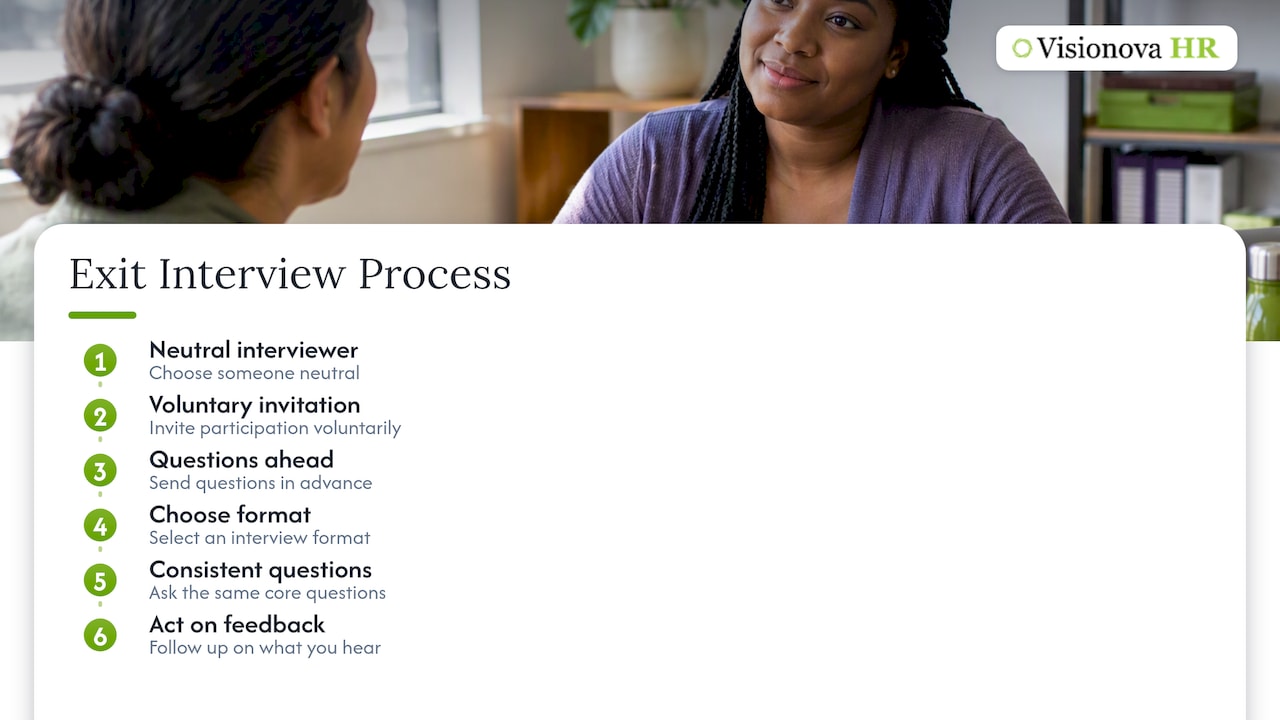
1. Decide who runs it
Choose someone the employee can trust to be neutral. Guidance for employers recommends selecting neutral, trusted interviewers and reviewing relevant personnel information beforehand. In a 30-person company, that might be the CEO, an operations lead from another team, or an outside HR advisor. If the departing person’s manager is the problem, that manager should not be in the room.
2. Invite everyone, and make it voluntary
Offer the interview after both voluntary and involuntary separations, and schedule it as close to the last day as practical. Public-sector guidance describes participation as voluntary but strongly encouraged, with the purpose explained up front. Say it in your own words: “We’re asking everyone who leaves. You can skip any question. What you tell us is meant to help us get better.”
Never make final pay, a reference or a severance offer depend on taking part.
3. Send questions ahead
The USDA’s exit-interview guide suggests sending questions in advance and using video or phone when an in-person meeting isn’t possible. This is kind, and it gets better answers: people think before they speak.
4. Choose the format
Risk-management guidance notes that an oral interview is better for sensitive issues, while a written questionnaire fits when a meeting can’t be scheduled or the employee is more comfortable writing. Offer both. Decide ahead of time how you will document: handwritten notes, typed summary, or the employee’s own written form. Recording tends to capture everything and make people guarded, so we don’t recommend it for most small employers.
5. Ask the same core questions every time
A standard question set makes patterns visible and keeps interviewers from wandering into irrelevant or risky territory. Use 8 to 10 questions and keep it under an hour.
6. Act on what you hear
Write a one-page summary, share themes (not names) with leadership, and assign an owner for each follow-up. More on that below.
What to ask: a usable script
Start low-risk, then move toward the harder questions.
- What did you like most about working here?
- What led you to start looking, or to decide to leave?
- Did you have what you needed to do your job well (tools, training, clear goals)?
- How would you describe the feedback and support you got from your supervisor?
- Did you feel your concerns were heard when you raised them?
- Did you experience or witness anything that felt unfair, disrespectful, or against the law, including harassment or discrimination?
- Were there any problems with your pay, breaks, schedule or time off that we should know about?
- What would have made you stay?
- What should we protect about this workplace, and what should we change first?
- Would you recommend us to a friend, and why or why not?
Question 6 follows guidance from a nonprofit employer association, which recommends asking whether the employee experienced or witnessed discrimination, harassment, or other illegal conduct and probing management fairness and responsiveness. Question 7 is our addition, because in California wage and hour problems are among the most common surprises.
If something serious comes up, don’t debate it and don’t promise confidentiality you can’t keep. Say: “Thank you for telling me. I take this seriously and I’m going to follow up through our process. Can you tell me more about what happened, who was involved, and when?” Then stop the interview, document what was said in the employee’s words, and start an investigation promptly. Our guide to high-risk terminations covers what to do when a departure is already tense.
What not to ask: anything about health conditions, family plans, immigration status, or their next employer’s pay beyond what they volunteer. A fixed script protects you here.
What an exit interview form should include
A written form should mirror your script, and also cover the logistics. A practical form has:
- Employee name, role, department, supervisor, start and end dates (leave out anything you would not use)
- Type of separation: resignation, termination, layoff, end of contract
- The 8 to 10 core questions, with space for free text
- A line stating that participation is voluntary and that answers may be shared in summary with leadership
- A checkbox: “I would like someone to follow up with me about something I raised”
- An offboarding checklist, kept separate from the feedback itself
The checklist matters. Nonprofit guidance recommends the exit process explain your reference policy, remind employees about continuing confidentiality obligations, collect keys, cards and equipment, and address access to password-protected data. Keep it separate so people don’t feel they are being interrogated while handing over a laptop.
What California adds
No California statute requires you to hold an exit interview. What the law does require around a departure still shapes how you run one.
- Personnel records. Current and former employees can ask in writing for a copy of records relating to their performance or any grievance, and the employer must respond within 30 calendar days. Employers must keep those records for at least three years after termination. Write your exit notes knowing the employee may someday read them: facts, quotes, no editorializing.
- Retaliation. Federal law gives employees who believe they were retaliated against routes to file complaints, with deadlines that vary by statute. An employee who raises a concern in an exit interview is protected from retaliation like anyone else, so never use what you hear to change a reference or contest benefits.
- Severance releases. If you pair an exit with a separation agreement, keep it narrow. The EEOC found it probable that one employer’s overly broad agreement interfered with employees’ rights to file charges and talk to the agency. Have an employment attorney review any release.
- Final pay and training. Final wage deadlines and harassment-training rules in California are strict. Our small business HR compliance action plan and our guide to harassment training in California walk through them in plain language.
Perspective: the interview is a mirror, not a verdict
I have sat on both sides of this table. As a leader, I’ve heard the sentence “I didn’t think anyone wanted to know.” As a consultant, I’ve watched owners react to that sentence defensively, and I understand why. It hurts to learn that someone carried a problem alone.
We believe exit interviews work when you treat them as a mirror. They show you how your managers handle concern, whether your policies are lived or only written, and where pressure erodes people’s confidence. The legal risk and the human cost are the same story told two ways: the employee who feels unheard is usually the same employee whose concern, if ignored, becomes a claim.
The most common mistake we see isn’t asking the wrong question. It is collecting answers, then filing them. Decide, before the first interview, who will read the summaries and how often. Quarterly is enough for most organizations under 150 people.
— Bernadette
Follow up so people see something change
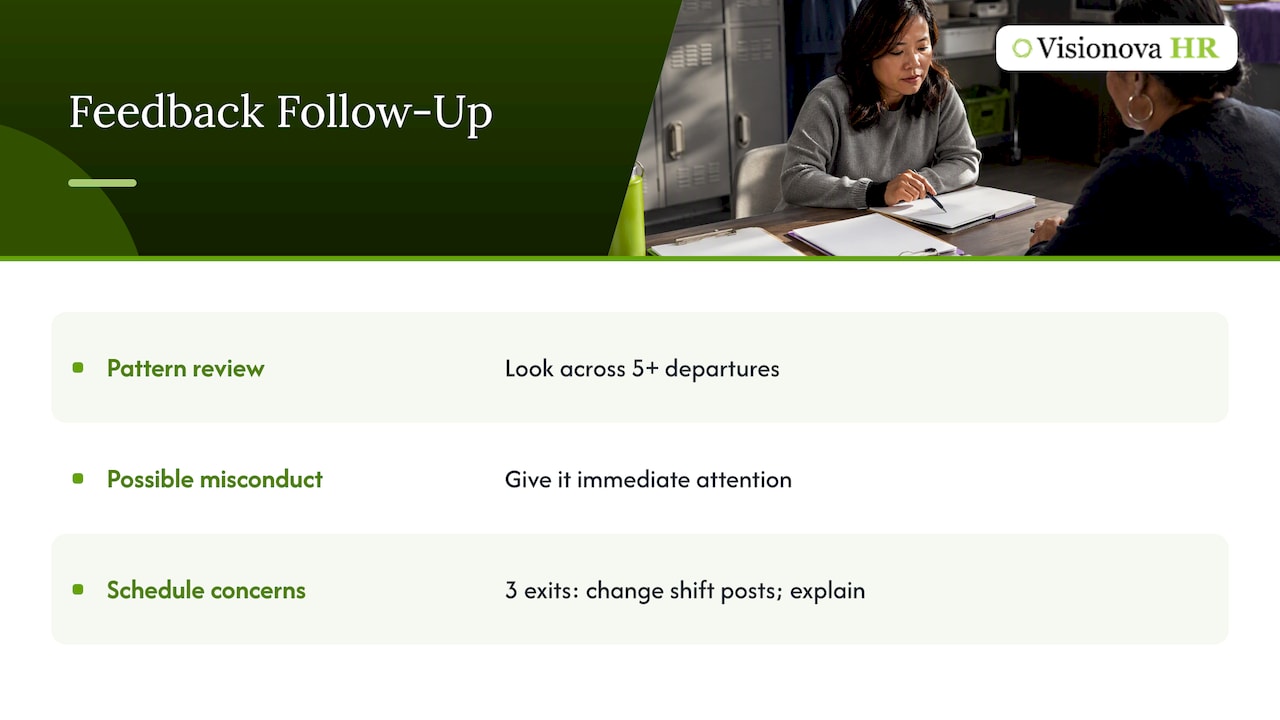
Look for themes across five or more departures rather than reacting to a single comment, unless it involves possible misconduct, which always gets immediate attention. Track how many people accept the interview, whether answers are specific enough to act on, and whether the same issues repeat. Public-sector guidance recommends monitoring participation and response quality and connecting feedback to action over time.
Then close the loop with the people still here. If three exits mention unclear schedules, change how you post shifts and tell the team why. For ideas on turning feedback into steadier retention, see these employee engagement strategies for small teams.
Where we can help
If you want a ready-made structure, our Compliance and Culture Roadmap is $890 and gives you a prioritized view of your people practices, including how you handle departures. If your handbook and offboarding paperwork haven’t been checked against current California rules, the Respect-Ready Compliance Check starts at $750.
FAQ
Do you legally have to do an exit interview in California?
No. We found no California or federal rule that requires one. Final pay, personnel records and anti-retaliation rules apply whether or not you hold an interview, so run it in a way that respects them.
Can an employee decline an exit interview?
Yes. Participation is voluntary, and the employee can skip any question. Offer a written form or a short call as alternatives, and never tie it to a reference or final pay.
Who should conduct the exit interview?
Someone neutral and trusted, who is not the employee’s direct supervisor. In a small organization that may be a senior leader from another area or an outside advisor.
How long should it take?
Plan for 30 to 45 minutes with about 10 standard questions. Longer interviews tend to drift, and short ones are easier to repeat consistently.
Sources
- Exit interviews, NSW Public Service Commission
- Conducting Exit Interviews, Minnesota Council of Nonprofits
- Exit interview guide, USDA Food Safety and Inspection Service
- Exit Interview Procedures, VFIS
- Personnel files and records, California DLSE
- Employment Law Guide: Whistleblower and Retaliation, U.S. Department of Labor
- Coleman Company and EEOC agreement
Recommended
- A Legal Guide to High-Risk Terminations
- Avoid Costly Leave Errors: CFRA vs FMLA Playbook for California Employers
- California Religious Accommodation: Manager Checklist and Scripts
- Workplace Conflict Mediation: 20 Minute Triage for California Managers
Note: This article is for general informational purposes only and is not legal advice. Employment decisions depend on your specific facts, applicable law, and jurisdiction, and California and local rules change often. Consult Visionova HR or qualified employment counsel before acting on your situation.