
Short answer: CFRA is California law, covers employers with five or more employees, and reaches further into an employee’s family than FMLA does. FMLA is federal, kicks in at 50 employees within 75 miles, and adds a 26-week military caregiver benefit CFRA doesn’t have. For most common leave reasons, the two run concurrently and cap out at 12 weeks. But in specific situations, CFRA and FMLA don’t overlap at all, and that gap is where employers get into trouble.
TL;DR:
- CFRA applies to employers with five or more employees, while FMLA covers only those with 50 or more employees within 75 miles, affecting eligibility and coverage.
- Leave for grandparents, siblings, grandchildren, and in-laws is exclusive to CFRA and does not run concurrently with FMLA, allowing additional protected time outside the FMLA bank.
- Pregnancy disability leave counts against FMLA, but not CFRA, enabling employees to have up to 24 weeks of protected leave if combining PDL, CFRA, and FMLA benefits.
- Wage replacement through state programs like SDI and PFL is separate from job protection under CFRA and FMLA, requiring employers to handle notices and documentation independently.
- Most leave disputes stem from poor communication or documentation rather than legal gaps, emphasizing the need for clear policies, manager training, and timely notices.
Table of Contents
- CFRA vs FMLA: The Comparison California Employers Need
- Who’s Actually Eligible, and Who’s Actually Covered
- When CFRA and FMLA Run Together, and When They Don’t
- Wage Replacement Is Not the Same as Job Protection
- Your Leave Request Checklist: What to Do This Week
- Why Most Leave Mistakes Aren’t Legal Mistakes
- Get Your Leave Policies Reviewed Before a Dispute Forces the Issue
- Sources
- FAQ
CFRA vs FMLA: The Comparison California Employers Need
I’ve sat across the table from small business owners who genuinely believed FMLA was the only leave law they had to worry about. They had 22 employees, no HR department, and no idea CFRA had covered them for years. That gap in understanding is where good employers accidentally become liable employers.
Here’s the split that matters most:
- Employer size threshold: CFRA applies to employers with five or more employees; FMLA applies only to employers with 50 or more employees within a 75-mile radius.
- Covered family members: CFRA includes a registered domestic partner, grandparent, grandchild, sibling, parent-in-law, and a designated person chosen by the employee. FMLA covers only spouse, child, and parent.
- Pregnancy leave: Pregnancy disability leave (PDL) runs separately from CFRA but counts against the FMLA bank, which changes how much bonding time is left afterward.
- Duration: Both laws cap general leave at 12 workweeks per 12-month period. FMLA alone extends to 26 weeks for employees caring for a covered servicemember.
That five-employee threshold under CFRA is newer than most owners realize. Senate Bill 1383, effective January 1, 2021, expanded CFRA to small employers and eliminated the old mileage requirement, catching a lot of California businesses off guard.
Who’s Actually Eligible, and Who’s Actually Covered
Eligibility and coverage are two different questions, and mixing them up is how employers deny leave they’re legally required to grant.
Employee eligibility under both laws requires 12 months of employment and 1,250 hours worked in the prior 12 months. Those hours generally must be actual time worked. Paid time off, holidays, and most leave time don’t count toward the 1,250-hour threshold, even though they count toward tenure.
Employer coverage is where the laws diverge sharply:
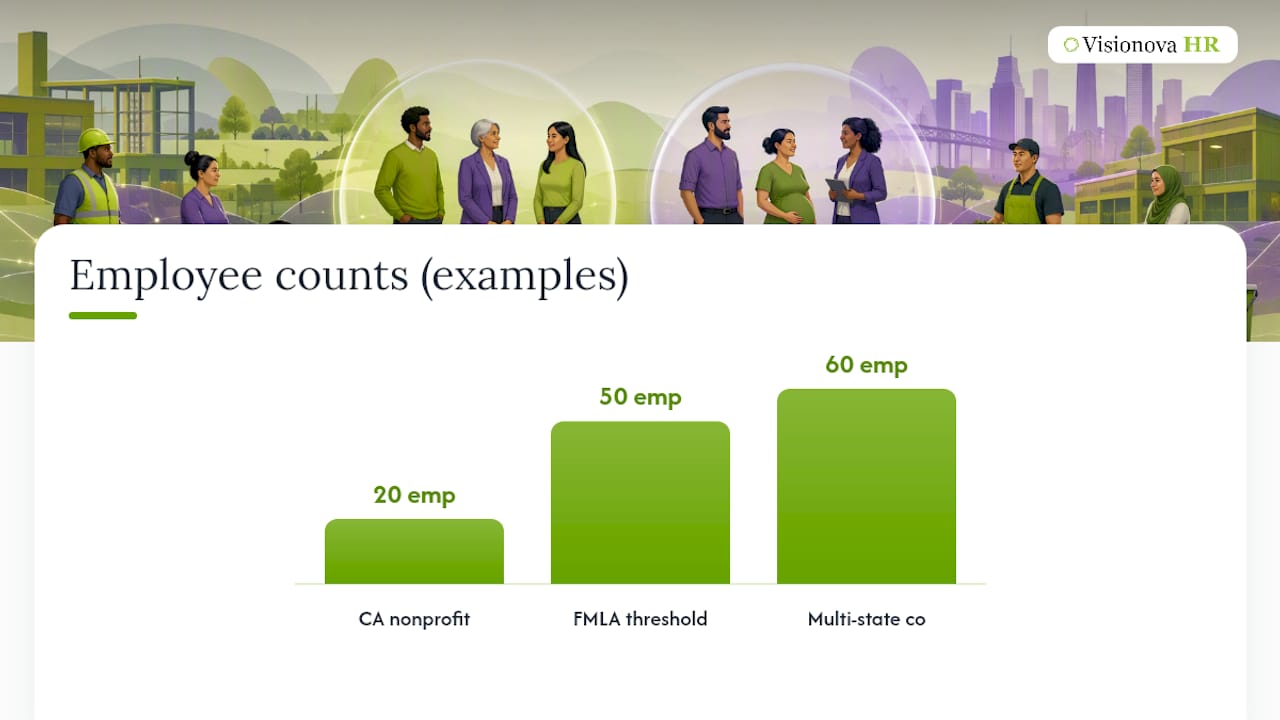
- A California nonprofit with 20 employees at one location is covered by CFRA. It is not covered by FMLA, because it falls under the 50-employee threshold.
- A 60-person company with staff spread across three states, none within 75 miles of each other, may not meet FMLA’s site-specific test even though it clears the headcount.
- Public agencies and public school employers are covered by FMLA regardless of size, a special carve-out that surprises school-affiliated nonprofits.
One more detail that trips up small employers: the 12-month period itself isn’t fixed by law. Employers can define it as the calendar year, a fixed 12-month period starting from an employee’s first leave date, or a rolling 12-month look-back. Whichever method you choose changes how much leave an employee has left at any given moment, so pick one, write it into your handbook, and apply it consistently. Applying different calculation methods to different employees is its own liability problem.
When CFRA and FMLA Run Together, and When They Don’t
Most leave requests trigger both laws at once, using up the same 12-week bank simultaneously. That’s true for an employee’s own serious health condition, a new child, or caring for a spouse, parent, or child with a serious health condition.
The exceptions are where employers either overprotect themselves out of unnecessary caution or underprotect themselves into a violation.
- CFRA-only reasons don’t touch the FMLA bank. Leave to care for a grandparent, sibling, grandchild, parent-in-law, or designated person is a CFRA right with no FMLA equivalent. An employee using eight weeks to care for a seriously ill grandparent has used zero FMLA weeks. If that same employee later needs FMLA-qualifying leave in the same 12-month period, the full 12 weeks are still there.
- Pregnancy disability leave changes the math. PDL runs separately from CFRA and can extend up to four months for pregnancy-related disability. That time counts against the employee’s FMLA bank but not against CFRA. So an employee can exhaust PDL against FMLA, then still take a full 12 weeks of CFRA bonding leave once the baby arrives, according to HRCalifornia’s leave interaction guidance.
- Military caregiver leave is FMLA-only, up to 26 weeks. CFRA has no equivalent provision, so this entire benefit sits outside the concurrent-running model.
Stack a CFRA-only reason correctly and an employee covered by both laws can reach up to 24 weeks of protected time in a single 12-month period, according to CalChamber’s analysis. That’s not a loophole. It’s how two separate statutes with different family definitions are built to work.
Pro Tip: Track CFRA-only leave separately from concurrent leave in your leave log from day one. If you lump every absence into one bucket, you won’t know an employee still has FMLA weeks in reserve until it’s too late to plan for it.

Wage Replacement Is Not the Same as Job Protection
This is the single most common mix-up I see among owners without an HR background, and it causes two opposite mistakes: denying leave because “EDD didn’t approve it,” or assuming an approved EDD claim means the job is automatically protected.
It isn’t automatic in either direction. State Disability Insurance (SDI) and Paid Family Leave (PFL), both administered by the Employment Development Department, pay a portion of wages during leave. Neither program grants or denies job-protected leave status. That determination lives entirely with CFRA and FMLA eligibility, decided separately by you as the employer.
A few coordination rules to build into your process:
- You can require employees to use accrued vacation or PTO concurrently with unpaid FMLA leave in many circumstances, but CFRA has narrower limits on what you can compel.
- Group health benefits must continue during CFRA and FMLA leave, on the same terms as if the employee were actively working.
- SDI and PFL applications run on their own timeline through EDD, separate from your internal leave paperwork, so don’t wait on an EDD determination before issuing your own eligibility notice.
Get the paperwork sequence backward and you’ll either delay wage replacement the employee is counting on or create the appearance that leave was denied when it wasn’t.
Your Leave Request Checklist: What to Do This Week
When an employee tells you they need time off for a health condition, a new baby, or a sick family member, here’s the sequence that keeps you compliant and keeps the relationship intact.
- Issue the eligibility notice within five business days of learning about the qualifying event. Use the language in CalHR’s Notice of Eligibility and Rights and Responsibilities as your template, even if you’re a private employer, because it covers the disclosures both laws require.
- Request medical certification only when appropriate, and know the limits. You may request a second opinion only with a good-faith, objective basis for doubt, and typically only for the employee’s own condition, not a family member’s. You pay for that second opinion.
- Plan for intermittent leave before it becomes a scheduling crisis. Ask employees receiving planned treatment to coordinate scheduling with your operational needs, and document every scheduling conversation in writing.
- Reinstate to an equivalent position, continue health benefits without interruption, and document any accommodation discussions that happen on return. If a return-to-work situation turns contentious, our guide on handling high-risk terminations walks through the documentation habits that protect you later.
A manager script that works: “Thanks for telling me. I want to get this right for you, so I’m going to confirm the details and get you a written notice within five business days. In the meantime, nothing changes about your job status.”
Pro Tip: If a leave request involves a family member outside spouse, parent, or child, ask yourself immediately whether it’s CFRA-only. That single question determines whether you’re spending FMLA weeks you didn’t need to spend.
Escalate to Visionova or employment counsel when facts suggest the employee disputes your eligibility determination, when a certification looks fabricated, or when a return-to-work request involves a disability accommodation that overlaps leave law.
Why Most Leave Mistakes Aren’t Legal Mistakes
I’ve reviewed enough leave files to know the actual failure point almost never starts with the law. It starts with a manager who thinks an EDD approval means the job is safe, or who denies a grandparent-care request because “that’s not what FMLA covers” without ever checking CFRA. Those are documentation and training gaps wearing a legal costume.
In my experience, the most difficult leave situations are rarely caused by one missing legal rule. They develop when overlapping requirements, manager assumptions, and incomplete communication collide. That is why I caution employers against treating a leave request as a simple form-processing exercise. The facts, the communication, and the operational response all have to be considered together.
Running a version of our People Problem Triage™ on any leave request forces you to separate three questions before you act: is this a compliance issue, a documentation issue, or a communication issue? Most leave disputes that turn into complaints or litigation trace back to the third one. The law was probably followed. Nobody explained it to the employee in a way they trusted.
If you’re not confident your handbook language and manager training reflect the current CFRA and FMLA interaction rules, a leave audit is the single highest-leverage thing you can do this quarter. Save the call to outside counsel for cases where facts already point toward a dispute or retaliation claim, not as your first move on a routine request.
— Bernadette
Get Your Leave Policies Reviewed Before a Dispute Forces the Issue
Visionova HR Consulting is the practical alternative to guessing your way through a leave request or paying a law firm’s hourly rate to answer a question a well-written handbook should already answer. We work with California employers who have 10 to 150 employees and no in-house HR team, which means we build compliance tools you can actually use, not memos that sit unread.
Some consulting firms offer leave-policy audits, handbook language updates, and manager coaching to help teams improve their understanding of leave eligibility. These services are sometimes delivered as fixed-fee engagements with defined turnaround times.
If a specific case already involves a disputed termination or a return-to-work conflict, our guide to handling high-risk terminations is the right place to start, and it will tell you plainly when the situation calls for outside counsel instead. For everything short of that, book a session with our team and get your leave process reviewed before the next request lands on your desk.
Sources
- Family and Medical Leave Act and California Family Rights Act FAQs (EDD)
- Family Care and Medical Leave: Quick Reference Guide (California Civil Rights Department)
- Family and Medical Leave Act (DOL)
- CFRA and FMLA in Practice – Leave Interactions (HRCalifornia / CalChamber)
- Human Resources Manual – CalHR
Employers updating onboarding paperwork alongside leave notices may also find this new hire paperwork checklist useful for keeping notice timelines organized.
This article is general information, not a substitute for advice from a qualified lawyer. Consult a qualified legal professional about your own circumstances before acting on anything here.
FAQ
Is CFRA Better Than FMLA?
Neither law is “better.” CFRA covers more family members and applies to smaller employers, while FMLA adds the 26-week military caregiver benefit CFRA lacks. Where they overlap, the more protective provision generally controls for the employee.
Can I Take FMLA and CFRA Separately?
Yes, in specific cases. A CFRA-only reason, like caring for a grandparent, doesn’t use any FMLA time, so an employee can later take a full separate 12 weeks under FMLA in the same year if a qualifying reason arises.
Do I Get Paid While on CFRA Leave?
CFRA and FMLA are both unpaid, job-protected leave. Wage replacement comes separately through State Disability Insurance or Paid Family Leave, administered by EDD, and isn’t automatic just because your leave was approved.
Can My Employer Deny My CFRA Leave?
An employer covered by CFRA can deny leave only if the employee doesn’t meet the eligibility test (12 months of employment, 1,250 hours worked) or the reason doesn’t qualify. A covered employer cannot deny leave simply because staffing is tight.
Recommended
Note: This article is for general informational purposes only and is not legal advice. Employment decisions depend on your specific facts, applicable law, and jurisdiction, and California and local rules change often. Consult Visionova HR or qualified employment counsel before acting on your situation.