
California overtime rules require 1.5 times regular pay after 8 hours in a workday or 40 hours in a workweek, and double time after 12 hours in a day or 8 hours on a seventh straight day. Nonexempt employees are covered; exemptions and alternative workweek schedules change how the rules apply. Employees should check pay stubs against time records now. Employers should audit classification and payroll math before a small error becomes a wage claim.
TL;DR:
- California’s overtime rules require that employees working beyond 8 hours in a day or 40 hours in a week receive 1.5 times their regular pay, with double time applying after 12 hours or beyond 8 hours on the seventh consecutive day.
- Many payroll systems and templates, especially those built for other states, often fail to accurately calculate overtime for the seventh-day work pattern, risking underpayment.
- Accurate overtime pay depends on correctly calculating the regular rate, including all nondiscretionary bonuses and commissions, not just base wages.
- Employers must verify exemption qualifications and properly document alternative workweek schedules, or they risk retroactive overtime liabilities and wage claims.
- Regular audits of classifications, regular-rate calculations, and workweek documentation can prevent costly errors and ensure compliance.
Table of Contents
- Overtime Rules California Employers and Employees Need to Know
- How Is Overtime Calculated? The Regular Rate of Pay, Explained
- Who’s Exempt, and What Alternative Workweek Schedules Require
- Employer Checklist: Common Overtime Payroll Mistakes to Fix Now
- What to Do If You’re Not Paid Correctly
- Overtime Rules for Agriculture and Healthcare Workers
- How the California Fair Pay Act Affects Overtime Calculations
- Meal and Rest Breaks: How They Affect Overtime Eligibility
- Compliance Is Risk Management and Good People Practice
- Get Overtime Compliance Support From Visionova
- Where to Verify These Rules Yourself
- Sources
Overtime Rules California Employers and Employees Need to Know
California doesn’t leave much room for guesswork on overtime. The rules live in Labor Code Section 510, and they’re more generous to workers than federal law in almost every scenario that matters.
Here’s the structure. Under Section 510, nonexempt employees must be paid 1.5 times their regular rate of pay for hours worked beyond 8 in a single workday, beyond 40 in a workweek, and for the first 8 hours worked on the seventh consecutive day in that workweek. Double time kicks in after 12 hours in a workday, and also applies to any hours past 8 on that seventh consecutive day. These thresholds apply to nonexempt employees 18 and older, along with minors 16 to 17 who aren’t subject to compulsory schooling.
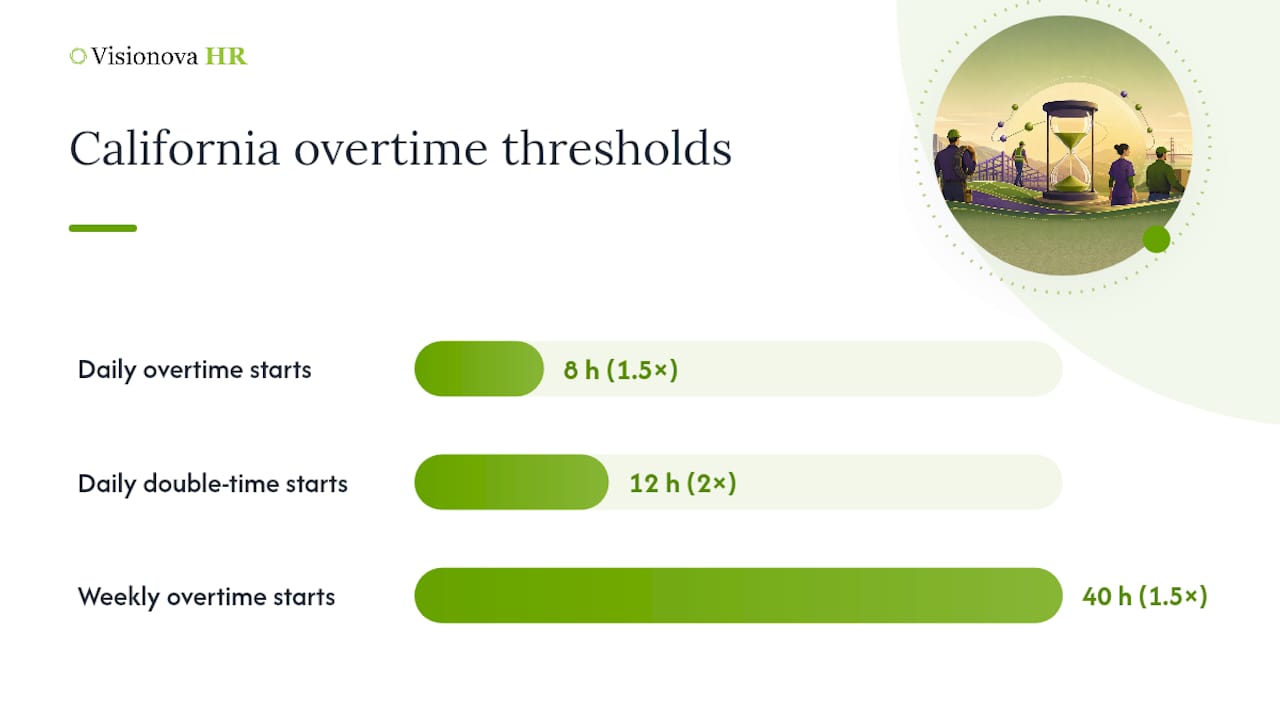
A few terms carry specific legal weight here. A “workday” is any consecutive 24-hour period starting at the same time each day, defined by the employer. A “workweek” is any seven consecutive 24-hour periods, starting on a fixed day the employer sets. The “seventh consecutive day” rule doesn’t care about the calendar week. It counts seven straight days worked in a row within that defined workweek, regardless of which days those are.
Here’s how the thresholds actually play out in a payroll office:
- A 9-hour shift. The employee works 1 hour of daily overtime at 1.5x, even if the total for the week stays under 40 hours. Daily and weekly overtime are separate triggers, and daily overtime doesn’t wait for the weekly count.
- A 13-hour shift. Hours 9 through 12 get paid at 1.5x. Hour 13 and beyond get paid at 2x. A single long day can generate both premium rates in the same shift.
- Working a seventh consecutive day. If an employee works all seven days of the defined workweek, the first 8 hours on that seventh day are paid at 1.5x, and anything beyond 8 hours that day jumps to 2x, even if the employee only worked 4 hours on each of the prior six days.
That third scenario trips up more employers than the other two combined. Payroll systems built around a simple 40-hour weekly overtime rule often miss the seventh-day trigger entirely, because the employee’s weekly total might still fall under 40 hours. California doesn’t measure only totals. It measures the pattern of days worked.
The practical implication: if your timekeeping software wasn’t configured specifically for California overtime pay rules, you’re likely underpaying somewhere. Generic payroll templates built for other states routinely miss daily overtime and the seventh-day premium because most states only require the 40-hour weekly standard set by federal law.
How Is Overtime Calculated? The Regular Rate of Pay, Explained
Every overtime calculation in California starts with one number: the regular rate of pay. Get this number wrong, and every overtime dollar that follows is wrong too.
The regular rate isn’t simply an hourly wage. It’s a blended figure that must include:
- Hourly earnings for all hours worked
- Salary, converted to an hourly equivalent
- Piece-rate earnings
- Commissions
- Nondiscretionary bonuses (attendance bonuses, production bonuses, anything promised in advance based on a formula)
It typically excludes discretionary bonuses (a surprise holiday bonus with no preset formula) and expense reimbursements, since those aren’t compensation for hours worked. Employers frequently miscalculate the regular rate by leaving out nondiscretionary bonuses and commissions, which quietly inflates unpaid overtime liability every pay period those premiums apply.
Pro Tip: If your commission or bonus plan has any preset formula, no matter how small the payout, treat it as nondiscretionary and fold it into the regular rate before calculating overtime. Guessing wrong here compounds every pay period you don’t catch it.
Here’s a step-by-step approach for an hourly employee earning a commission:
Suppose an employee earns $20/hour, works 45 hours in a week, and earns a $200 nondiscretionary commission that week. First, calculate straight-time pay: 40 hours at $20 equals $800. Add the $200 commission, giving total straight-time earnings of $1,000 for 40 hours, which works out to a regular rate of $25/hour. The 5 overtime hours get paid at 1.5 times that $25 rate, or $37.50/hour, adding $187.50. Total pay for the week: $1,187.50.
For a salaried nonexempt employee, the process starts by converting salary to an hourly figure. Divide the weekly salary by 40 hours to get the base hourly rate, then apply the same regular-rate logic, adding in any nondiscretionary pay before calculating premiums. Salary conversions get complicated fast when bonuses or commissions are layered in over a pay period longer than a week, since the nondiscretionary pay has to be allocated proportionally across the period before you can calculate an accurate weighted regular rate.
The most common mistake isn’t a math error. It’s a scope error: leaving nondiscretionary pay out of the regular rate entirely, then calculating overtime only on the base hourly or salary figure.
Who’s Exempt, and What Alternative Workweek Schedules Require
Not every employee qualifies for overtime pay in California, but the bar for exemption is higher than most small employers assume.
Executive, administrative, and professional employees can be exempt from overtime, but only if they satisfy both a salary test and a duties test defined by the applicable IWC Wage Order for their industry. A job title alone never creates an exemption. An “office manager” who spends most of the week on routine, non-discretionary tasks is likely still nonexempt, regardless of what the offer letter calls the position.
Industry-specific nuances add another layer:
- Certain drivers are governed by federal Department of Transportation hours-of-service rules rather than standard state overtime thresholds.
- Healthcare workers often operate under modified scheduling provisions tied to their specific Wage Order, particularly around meal-period waivers for longer shifts.
- Agricultural workers have phased-in overtime thresholds that shifted over recent years as the state moved agricultural employees toward the standard 8-hour/40-hour structure.
- Employees under a valid collective bargaining agreement may have overtime terms that differ from the default statute, provided the agreement meets specific statutory conditions.
Alternative workweek schedules, like four 10-hour days instead of five 8-hour days, are legal under Labor Code Section 511 but only when adopted through a strict procedure: a proposal describing the schedule, a secret-ballot vote among affected employees in the work unit, at least two thirds approval, and proper advance notice. Skip any step, and the schedule is invalid. That means every hour past 8 in a day reverts to standard daily overtime, retroactively, even if employees genuinely preferred the compressed schedule.
This is where a surprising number of overtime disputes actually originate. Employers rarely misunderstand the 8-hour and 40-hour thresholds themselves. They stumble on the procedural mechanics of adopting an alternative schedule, then get blindsided months later by a wage claim built entirely on a missing vote record.
Employer Checklist: Common Overtime Payroll Mistakes to Fix Now
If you run payroll for a small business or nonprofit, here’s where to start looking for exposure before an employee, or the Labor Commissioner, finds it first.
- Audit every exempt classification. Confirm each exempt role actually meets the salary and duties test under its Wage Order. Job titles don’t grant exemptions.
- Recalculate the regular rate. Pull three recent pay periods and check whether nondiscretionary bonuses or commissions were included before overtime premiums were calculated.
- Verify salary-to-hourly conversions. Make sure any salaried nonexempt employee’s overtime is based on a correctly converted hourly rate, not the salary alone.
- Confirm alternative workweek documentation exists. If any team works four 10-hour days, locate the signed ballots and written notices. If they don’t exist, the schedule isn’t valid.
- Tighten timekeeping and manager training. Managers need to understand that overtime is owed whenever work is “suffered or permitted,” whether or not it was formally authorized in advance.
The remediation step that gets skipped most often: once you find a calculation error, fix it going forward and review the lookback period, since underpaid overtime compounds across every affected pay cycle.
Pro Tip: A quarterly payroll spot-check, reviewing classifications, regular-rate math, and alternative-workweek paperwork, catches most overtime problems long before they become expensive. You don’t need a full annual overhaul if you’re checking these three things every few months.
If an audit surfaces a pattern rather than a one-off error, or if you’re unsure whether a role truly qualifies as exempt, bring in an HR advisor or payroll counsel before you make changes. Have job descriptions, recent pay stubs, and any alternative workweek records ready. That documentation is usually what determines how a dispute gets resolved.
What to Do If You’re Not Paid Correctly
If your paycheck doesn’t reflect the hours you actually worked, start by pulling your own records: time punches, schedules, pay stubs, and any texts or emails referencing hours worked. Try resolving it internally first. Many miscalculations are honest payroll errors, not deliberate underpayment, and a direct conversation with HR or payroll often fixes it faster than a formal claim.
If internal resolution doesn’t work, employees can file a wage claim with the California Labor Commissioner’s Office, which provides the forms and instructions needed to start the process. Attach your time records, pay stubs, and a written summary of the unpaid hours.
Remedies can include back pay for the unpaid overtime, and depending on the circumstances, additional penalties. Timelines vary depending on case complexity and whether the employer contests the claim, and some disputes settle before reaching a hearing.
- California law prohibits retaliation against employees who file a wage claim or discuss pay with coworkers.
- Employers responding to a claim should gather the same documentation the employee is asked to provide, timecards, payroll records, and any exemption or alternative-workweek paperwork, rather than treating the claim as adversarial from the start.
- A defensive, disorganized response to a wage claim often does more reputational and legal damage than the original payroll error.
Overtime Rules for Agriculture and Healthcare Workers
Agriculture and healthcare each carry meaningful departures from the standard California overtime framework, and treating them like every other industry is a common employer mistake.

Agricultural employees historically operated under a separate, higher overtime threshold than most workers. That gap has been closing through a phased schedule that gradually moved agricultural workers toward the standard 8-hour daily and 40-hour weekly thresholds that apply broadly under Labor Code Section 510. Employers in agriculture should confirm exactly where their operation sits in that phase-in rather than assuming the general standard applies uniformly, since transition timing has varied by employer size.
Healthcare presents a different kind of nuance. Many healthcare facilities operate on longer shifts, 10 or 12 hours, built around patient coverage needs, and the applicable Wage Order for the healthcare industry includes specific provisions addressing meal-period waivers on those extended shifts. That doesn’t eliminate overtime obligations. It changes how meal breaks interact with shift length, which in turn affects how overtime gets calculated if a waiver isn’t properly documented.
Both industries share a common risk: assuming an industry-wide exception applies broadly to every role in the organization, without checking the specific Wage Order and job classification. A single facility can have a mix of exempt administrators, nonexempt clinical staff, and workers covered by industry-specific scheduling provisions, all under one roof.
How the California Fair Pay Act Affects Overtime Calculations
The California Fair Pay Act doesn’t change the overtime thresholds themselves, but it changes what happens when pay disparities intersect with overtime calculations. The law requires equal pay for substantially similar work regardless of gender, race, or ethnicity, and it restricts employers from justifying pay differences with factors like prior salary history.
Here’s where the two issues connect: if two employees performing substantially similar work have different base rates, and both regularly work overtime, any unjustified pay gap gets magnified every time overtime premiums are calculated.
That compounding effect is exactly why pay equity audits and overtime audits shouldn’t happen in isolation. An employer that only reviews classifications and regular-rate math, without also checking whether comparable roles are paid equitably, can walk away from a “clean” overtime audit while still carrying real Fair Pay Act exposure. The fix isn’t complicated: when you review your regular-rate calculations, run a parallel check on base pay across similar roles at the same time.
Meal and Rest Breaks: How They Affect Overtime Eligibility
California meal break law and overtime eligibility intersect more than most employers expect, and getting them confused creates two separate categories of liability instead of one.
Nonexempt employees are generally entitled to a 30-minute unpaid meal break when they work more than 5 hours in a day, and a second meal break when they work more than 10 hours, unless properly waived. Rest breaks, typically 10 paid minutes for every 4 hours worked, run separately and don’t affect overtime calculations the way meal breaks can. Here’s the connection to overtime: an improperly provided or waived meal break doesn’t create additional overtime hours on its own, but it does create a separate premium, generally one additional hour of pay at the employee’s regular rate, for each missed or noncompliant meal period, and that additional payment must itself be factored into subsequent regular-rate calculations if the violation occurs during a week that also includes overtime.
Extended shifts common in healthcare and other 24-hour operations often rely on meal-period waivers built into the applicable Wage Order. If that waiver isn’t properly documented or the shift structure changes, the employer can end up owing both the missed meal premium and a corrected overtime calculation that reflects it. California meal break requirements and overtime rules aren’t two separate compliance projects. They’re one payroll calculation that has to account for both at once.
Compliance Is Risk Management and Good People Practice
Small employers tend to treat overtime compliance as a legal chore instead of an operational habit, and that’s usually where the trouble starts. The organizations that stay out of trouble aren’t the ones with the fanciest payroll software. They’re the ones that check classification, regular-rate math, and alternative-workweek paperwork on a fixed schedule, not just when something feels off.
Where organizations most often under-resource this: exempt classifications set at hire and never revisited as job duties shift, and alternative workweek schedules adopted informally without the required vote. A simple quarterly self-audit closes both gaps.
— Bernadette
Get Overtime Compliance Support From Visionova
Visionova is the practical alternative to guessing your way through California’s overtime rules, or paying a law firm’s hourly rate just to find out where your payroll math went wrong. We run payroll classification audits, rebuild employee handbooks so overtime and meal-break policies are stated clearly, and deliver manager training so the people approving hours actually understand what “suffered or permitted” means before it becomes a wage claim.

A typical engagement starts with an assessment of your current classifications, regular-rate calculations, and any alternative workweek documentation. From there, we prioritize the fixes that carry the most liability first, then follow up to confirm the corrections held. If your organization is also navigating a termination that touches overtime or wage disputes, our guide to high-risk terminations walks through the documentation you’ll need.
If you want to see how our compliance and manager training work in practice, join us at SHRM 2024 to talk through your specific payroll setup and get a prioritized action plan.
Where to Verify These Rules Yourself
For the statutory language itself, consult Labor Code Section 510 directly. To file a wage claim, use the DIR’s filing instructions. For federal comparison, see the Department of Labor’s FLSA overview.
This article is general information, not a substitute for advice from a qualified lawyer. Consult a qualified legal professional about your own circumstances before acting on anything here.
Recommended
- A Legal Guide to High-Risk Terminations
- HR’s Strategy for Peacekeeping: Join Us at SHRM 2024 | Visionova HR Consulting
Made with help from BabyLoveGrowth
Note: This article is for general informational purposes only and is not legal advice. Employment decisions depend on the facts, applicable law, and jurisdiction. Consult qualified employment counsel for guidance on your specific situation.