
Under California law, employers must reasonably accommodate an employee’s sincerely held religious beliefs and practices unless doing so would cause a genuine undue hardship. The California Civil Rights Department and the EEOC both enforce this duty, and the process almost always starts with a conversation, not a lawsuit. That conversation, called the interactive process, is where most employers either get it right or create a problem they didn’t need to have.
TL;DR:
- Employers can deny religious accommodation requests only if they cause significant difficulty or expense, not merely because of inconvenience or personal preference.
- Requests should be clearly communicated and documented, including the specific need, discussion details, and final decision, to withstand legal scrutiny.
- Accommodations often involve flexible scheduling, prayer breaks, dress code adjustments, or task reassignments, but segregating employees is not lawful.
- Handling requests with a consistent, documented process reduces legal risk and demonstrates a respectful workplace culture.
- Internal escalation and thorough recordkeeping are essential before filing complaints with civil rights agencies, especially in cases of denial or dispute.
Table of Contents
- What Counts as Religious Accommodation California Employers Must Provide
- When Can Employers Legally Deny a Religious Accommodation Request?
- How Do You Request a Religious Accommodation at Work in California?
- Common Examples of Reasonable Accommodations in California
- What Happens If Your Accommodation Request Is Denied?
- Manager-Ready Checklist and Scripts for Handling Requests
- Why Accommodation Is Both a Legal Duty and a Culture Win
- How Supports Accommodation Compliance
- Where to Verify These Legal Requirements
- Sources
What Counts as Religious Accommodation California Employers Must Provide
California’s Fair Employment and Housing Act (FEHA) defines “religious creed” broadly. It covers traditional organized religion, as well as sincerely held ethical or moral beliefs that function like religion in the person’s life, even if no formal institution backs them up. A manager doesn’t get to decide whether a belief is “real enough” to count.
Under Gov. Code § 12940 and its implementing regulations, employers must adjust schedules, dress codes, grooming rules, or job duties when a sincerely held belief conflicts with a workplace requirement. California goes further than federal law in one important way: state regulations explicitly reject segregating a religious employee away from customers or coworkers as an acceptable fix, even when the employer thinks it solves the conflict.
When Can Employers Legally Deny a Religious Accommodation Request?
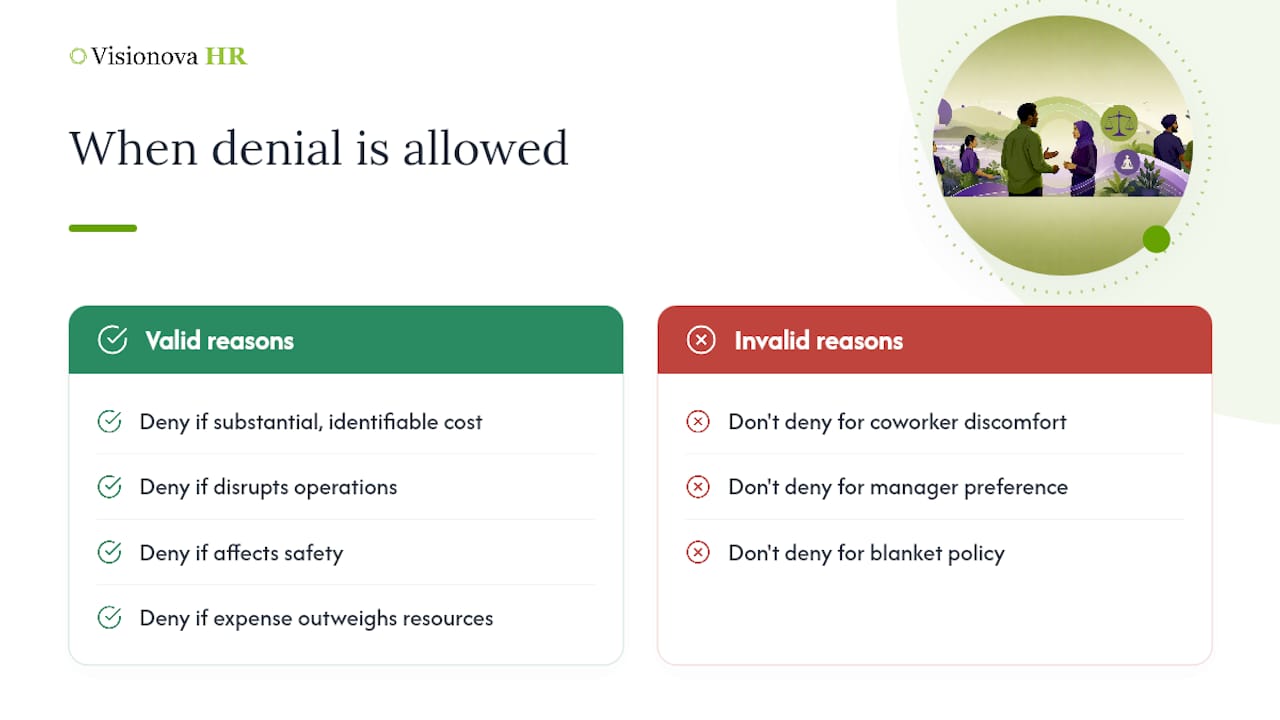
Not every request has to be granted. FEHA lets an employer deny one only if it would cause “significant difficulty or expense,” weighed against the size of the business, its resources, and the nature of the operation. This is a strict legal test, not a gut feeling.
The 2023 Supreme Court decision in Groff v. DeJoy raised the federal bar under Title VII, requiring employers to show substantial, identifiable costs rather than minor inconvenience. California’s standard was already close to that level, so the practical effect for most CA employers is a stricter ceiling than a lot of managers assume.
Here’s what does not meet the bar: a coworker’s personal discomfort, a manager’s preference for uniformity, or “that’s just our policy.” Blanket no-exceptions rules almost always fail this test. Before denying anything, ask honestly whether the accommodation actually disrupts operations, cost money you can document, or affects safety, versus whether it just feels unfamiliar.
How Do You Request a Religious Accommodation at Work in California?
The request doesn’t need magic words, but clarity helps both sides move faster.
- State the belief and the conflict. Example script for an employee: “I have a sincerely held religious practice that requires [specific need, e.g., Friday sundown off, a head covering, a midday prayer break]. Can we find a way to make that work with my schedule?”
- Employer acknowledges the request within a few business days, in writing where possible.
- Employer asks clarifying questions about frequency, timing, and flexibility, not about the theology behind the belief.
- Both sides discuss alternatives until they land on something workable or determine none exists.
- Employer documents what was asked, discussed, and decided.
Pro Tip: Never let a verbal “no problem” stand alone. Even an approved accommodation should get a one-line email confirming what was agreed to, so nobody’s relying on memory six months later.
Retaliating against an employee for making this request, even if you ultimately deny it, is its own separate violation. Keep those two decisions completely separate in your head and in your paperwork.
Common Examples of Reasonable Accommodations in California
Most requests are more modest than employers expect. According to EEOC guidance, typical accommodations include:
- Flexible scheduling for Sabbath observance or holy days
- Short, unpaid prayer breaks at set times during a shift
- Exceptions to dress or grooming policies (head coverings, beards, jewelry)
- Shift swaps arranged voluntarily between coworkers
- Limited reassignment of a specific task that conflicts with a belief
Enforcement is active: California’s CRD has secured numerous settlements related to religious discrimination and accommodation failures since 2020, and it published a factsheet in 2026 aimed at helping employers avoid such issues. Segregating an employee to the back office to “solve” a grooming or dress conflict is not a lawful substitute for a real accommodation.
What Happens If Your Accommodation Request Is Denied?
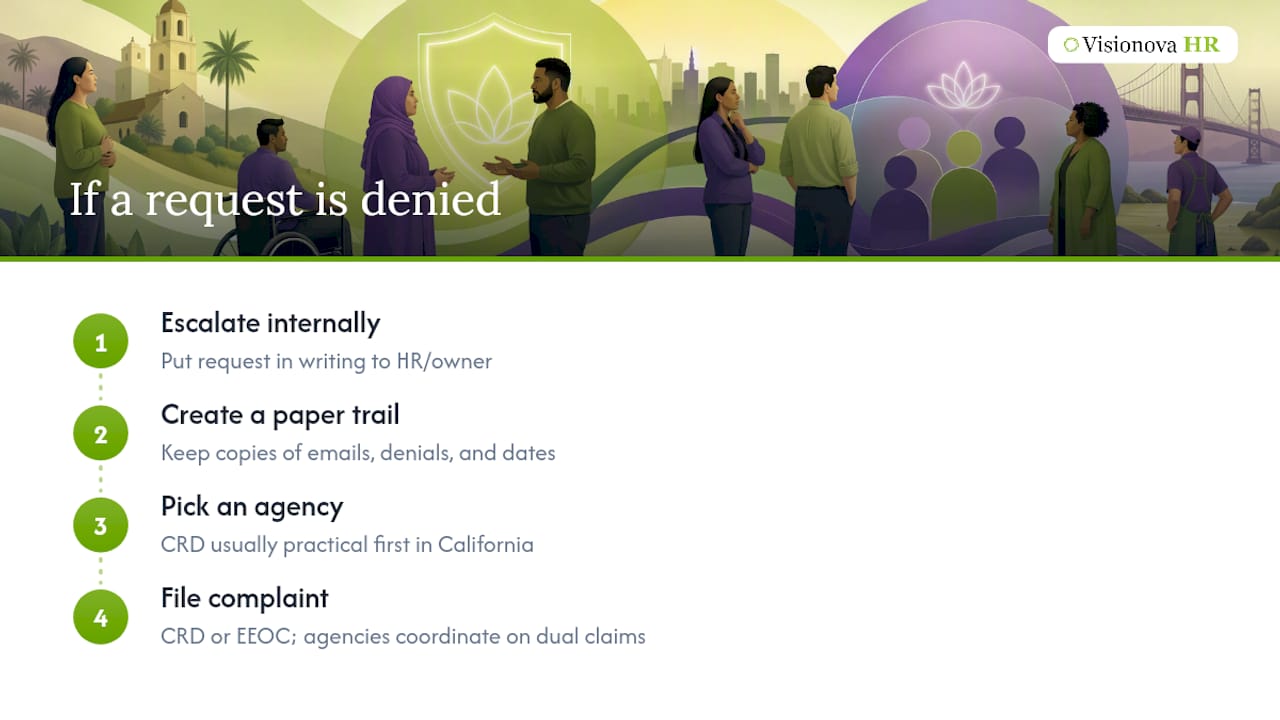
An employee can file a complaint with the California Civil Rights Department, which generally covers a longer filing window than the EEOC’s federal Title VII process. Because California and federal protections overlap, employees sometimes have a choice of where to file, and the agencies coordinate on dual-filed claims. When both apply, filing with the CRD first is usually the more practical route for a California workplace.
Before filing anywhere, escalate internally: put the request in writing to HR or ownership, keep copies of every email and any denial received, and note dates. If the business has no HR function, that internal step might just be a direct conversation with the owner, but the paper trail still matters. Once a complaint is filed, missing documentation is often the difference between a fast resolution and a drawn-out investigation.
Manager-Ready Checklist and Scripts for Handling Requests
You don’t need a law degree to handle this correctly. You need a repeatable process.
Five-step checklist:
- Intake — Write down exactly what the employee asked for, in their words.
- Engage — Ask clarifying questions about scope and frequency, not about their faith itself.
- Explore alternatives — Brainstorm two or three options before deciding anything is impossible.
- Document — Record the request, discussion, options considered, and final decision.
- Follow up — Check in after 30 days to confirm the accommodation is still working for both sides.
Script to acknowledge a request: “Thanks for bringing this to me. I want to make sure I understand what you need. Can you walk me through how this typically works and how often it comes up?”
Script to offer an alternative: “I can’t do exactly what you asked because of [specific, documented reason]. Here’s what I can offer instead. Does this work, or is there a version of this that would?”
Your documentation should capture: the date and exact wording of the request, the nature of the conflict, options proposed, alternatives considered, cost estimates if relevant, your decision rationale, and a follow-up date. If the situation touches safety, union contract terms, or looks headed toward a denial you can’t clearly justify, loop in employment counsel or an HR advisory partner before you respond. This isn’t legal advice, and a five-minute call now beats a settlement later.
Why Accommodation Is Both a Legal Duty and a Culture Win
Most small employers I talk to treat religious accommodation as a compliance chore they hope never comes up. That’s backwards. The businesses that handle these requests well aren’t the ones with the fanciest policy binder. They’re the ones where a manager already knows how to have the conversation before the first request ever lands on their desk.
A visible, consistent process does two things at once: it lowers your legal exposure, and it tells every employee watching how the workplace treats people who are different from the majority. That second part is the one that keeps good employees from quietly job hunting. Train your managers, respond quickly, keep records, and treat the checklist as muscle memory, not paperwork you dust off during a crisis.
— Bernadette
How Supports Accommodation Compliance
Some HR consulting firms provide an alternative to hiring outside employment counsel for routine accommodation questions, offering practical HR support for small nonprofits and businesses.

Services often include building accommodation policy language into employee handbooks, running custom training so managers recognize requests, and providing on-call support for complex cases. If a request has escalated into a dispute or a possible termination, our guide to high-risk terminations walks through what to document before you act. For managers who want deeper training on handling sensitive workplace issues under pressure, our SHRM 2024 session on workplace peacekeeping is a practical next step. None of this is a substitute for legal advice, and high-risk cases should always involve counsel. Consider consulting an HR advisory partner to get your accommodation process handbook-ready before the next request comes in.
Where to Verify These Legal Requirements
For primary sources: the CRD’s accommodation page explains California filing steps, the EEOC fact sheet covers federal Title VII rules, and California Government Code § 12940 contains the statutory language on undue hardship. For schedule-related conflicts, this meal break law overview adds useful context.
Sources
- Fact Sheet: Religious Accommodations in the Workplace — EEOC
- California Government Code § 12940 — Discrimination prohibited
Recommended
Note: This article is for general informational purposes only and is not legal advice. Employment decisions depend on the facts, applicable law, and jurisdiction. Consult qualified employment counsel for guidance on your specific situation.