Small business HR compliance means meeting your legal obligations across hiring, pay, leave, safety, and recordkeeping, and the single most valuable step you can take today is building a one-page checklist with a named owner. That owner tracks obligations tied to agencies like the Department of Labor, the EEOC, and OSHA. Firms like Visionova HR exist because most small employers need this system built for them, not explained to them.
TL;DR:
- Small businesses need to assign a dedicated owner to track compliance obligations across hiring, wage, safety, recordkeeping, and benefits domains.
- Over 177,000 workers received $259 million in back wages in fiscal year 2025, illustrating the high costs of wage and hour violations for small firms.
- A 90-day compliance plan includes auditing I-9 forms, verifying wage laws, updating posters, and establishing documented workflows with regular testing.
- Building a living system involves a single source of truth, clear ownership, and quarterly reviews, not just a one-time checklist.
- Outsourcing becomes necessary when hiring across states, facing multiple compliance issues annually, or dealing with high-risk terminations.
Table of Contents
- Eight Core HR Compliance Domains Every Small Business Must Track
- Why Compliance Failures Keep Happening
- Your 90-Day HR Compliance Checklist and Action Plan
- Building a Living Compliance System That Doesn’t Fall Apart
- When to Outsource HR or Bring in Dedicated Support
- Staying Audit Ready: Retention, Retrieval, and Response
- How Visionova Approaches Compliance Differently
- Treat Compliance Like an Operating System, Not a Project
- Get Hands-On Support for Your Compliance Gaps
- Sources
Eight Core HR Compliance Domains Every Small Business Must Track
Small business employment law does not live in one place. It spreads across at least eight domains, and missing one usually surfaces during a payroll audit or a departing employee’s complaint, whichever comes first.
- Hiring and onboarding. Job postings, I-9 verification, background check disclosures, and offer letters that match what you actually pay.
- Wage and hour. Correct minimum wage, overtime eligibility, meal and rest break rules, and accurate time tracking.
- Payroll and tax. Withholding accuracy, timely deposits, and correct final-pay timing when someone leaves.
- Benefits and leave. Health plan notices, FMLA eligibility tracking, and state paid sick leave accrual.
- Workplace safety. Required OSHA postings and injury logging where headcount triggers it.
- Recordkeeping. Personnel files, I-9 storage separate from personnel records, and payroll history.
- Termination and offboarding. Final paycheck rules, COBRA notices, and documentation that supports the decision.
- Data privacy. Limiting who can access sensitive employee records and how long you keep them.
Day to day, compliance in each domain looks less like a legal exercise and more like a habit. Are new hires’ I-9s completed within three business days? Does your handbook match what managers actually enforce? OSHA requires displaying specific workplace posters, and many employers with more than 10 employees must also log serious injuries and illnesses. You can find current posting requirements and templates through the Department of Labor’s poster page, which stays current as federal and state rules shift.
Why Compliance Failures Keep Happening
Wage and hour violations, particularly employee misclassification and overtime miscalculation, remain the most common and costly compliance failures small employers face. The Wage and Hour Division enforces this at scale, and the federal minimum wage floor of $7.25 an hour means little once you realize over 30 states set their own, higher rate that legally overrides it.
In fiscal year 2025, the Department of Labor recovered $259 million in back wages for nearly 177,000 workers — the highest recovery total since 2019. That is not a statistic about large corporations. Small employers make up a disproportionate share of these cases because they lack the systems to catch errors early.
The failures tend to cluster around a short list of causes:
- No single person owns compliance, so tasks fall through when the founder gets busy.
- Documentation lives in scattered emails and drawers instead of one system.
- Postings and I-9s go unchecked for years because nobody calendars a reminder.
- Managers enforce policy inconsistently across locations or shifts.
- Remote hires create obligations in states the business never planned to operate in.
Your 90-Day HR Compliance Checklist and Action Plan
A compliance training for small businesses program does not need to be elaborate to work. It needs an owner, a timeline, and a place to put the paperwork. Here is a sequence Visionova HR uses with clients building their first real system.
Days 1 to 30: Triage.
- Run an I-9 self-audit. Pull every current employee’s form and confirm it is fully completed, signed, and stored separately from personnel files.
- Do a payroll sanity check. Compare job titles against duties to catch obvious exempt/non-exempt misclassifications, and confirm your pay rate meets your state’s minimum wage, not just the federal one.
- Verify required posters are current and visible, including OSHA notices, wage and hour posters, and any state-specific leave notices.
- Review your handbook (or write one if you don’t have it) to confirm at-will language, harassment policy, and leave policies match current law.
Days 31 to 60: Build the system.
- Assign a compliance owner. It does not need to be a full-time HR hire. It needs to be one named person accountable for the checklist.
- Create a compliance calendar with filing deadlines: payroll tax due dates, EEO reporting windows if you meet the threshold, workers’ comp renewals, and poster update checks.
- Set up a document retention structure, one folder or drive per employee, with clear naming and a retention timeline attached.
Days 61 to 90: Test and reinforce.
- Run a mock audit. Pick five employee files at random and confirm every required document is present and current.
- Train managers on the handbook’s key policies, especially anti-harassment reporting and performance documentation.
- Schedule the next quarterly check before you close out this cycle, so the system doesn’t quietly lapse.
Pro Tip: Store your compliance calendar somewhere every owner or manager can see it, not buried in one person’s inbox. A shared calendar with color-coded deadlines catches more misses than any single person’s memory.
This sequence works because it separates urgent fixes (I-9s, postings, obvious misclassification) from structural fixes (ownership, calendars, training). Skipping straight to structure while your I-9s sit incomplete is how businesses end up explaining gaps to an investigator instead of preventing them.

Building a Living Compliance System That Doesn’t Fall Apart
A checklist you run once is a snapshot. A living compliance system is what keeps that snapshot accurate six months later, and it rests on three things: a single source of truth, clear ownership, and a testing cadence.
Your single source of truth is usually a living handbook paired with documented workflows, stored somewhere every manager can find it. When policy lives in three different versions across email threads, enforcement becomes inconsistent, and inconsistent enforcement is one of the fastest ways to lose a wrongful termination claim.
Ownership needs a backup. If your compliance owner is out sick when a workplace injury happens, someone else needs to know where the OSHA log lives. Pair ownership with an exception log, a simple record of when and why a manager deviated from standard policy. Without it, ad hoc decisions quietly become the new normal, and that pattern is exactly what shows up as evidence in an audit.
Set your monitoring cadence deliberately: quarterly spot checks on payroll and classification accuracy, with a full-scope audit once a year. That balance catches most errors before they compound, without turning compliance into a full-time job.
| Budget level | Tooling approach | Best fit |
|---|---|---|
| Minimal | Spreadsheet plus shared cloud drive | Small employer, single state |
| Moderate | Basic HRIS platform | Growing headcount, multiple locations |
| Higher investment | Retained HR consultant or counsel | Multi-state hires, prior compliance incidents |
When to Outsource HR or Bring in Dedicated Support
Certain triggers make the case for outside help obvious: hiring across state lines, a second or third compliance incident in a year, or a termination that carries real legal exposure. Federal anti-discrimination protections apply once you cross specific headcount thresholds, and knowing exactly when those thresholds hit you changes what you’re required to do.
Your options generally fall into four models:
- In-house HR hire. Best once headcount and complexity justify a full salary; slow to scale down if things quiet.
- Retained HR consultant. Flexible expertise on demand, without full-time overhead, well suited to organizations under 75 employees.
- HR subscription support. Ongoing access to guidance at a predictable monthly cost, good for steady but not constant needs.
- PEO (professional employer organization). Bundles payroll, benefits, and some compliance functions, but can limit flexibility on policy and culture decisions.
When evaluating any provider, ask how they handle multi-state changes, whether they document advice in writing, and what happens when a termination turns contentious. A provider who can’t answer clearly is a red flag worth taking seriously.
Staying Audit Ready: Retention, Retrieval, and Response
Retention minimums set your floor, not your ceiling. Federal rules require payroll records under the FLSA for three years and specific I-9 retention windows, but many states require longer, so verify your state’s rule before you shred anything.
A timed retrieval test tells you more about your actual audit readiness than any policy review. Pick a random employee and time how long it takes to produce their complete file. If it takes longer than a few minutes, your system has a gap that a real investigator will find faster than you did.
If a DOL, EEOC, or OSHA inquiry lands on your desk, work through this sequence:
- Confirm the scope of the request in writing before handing over documents.
- Pull the specific employee or department files requested, nothing broader.
- Loop in legal counsel or your HR advisor before responding to substantive questions.
- Document every communication with the agency, including dates and names.
How Visionova HR Approaches Compliance Differently
Visionova HR has spent more than 20 years building HR systems for organizations that never planned to need one, from small nonprofits to fast-growing mission-driven companies. That work has included leading sessions at SHRM’s national conference on workplace conflict resolution and publishing detailed guidance on documenting high-risk terminations before they become legal exposure.
One nonprofit client came to Visionova HR after a departing employee’s complaint exposed years of undocumented performance conversations. Rebuilding their handbook and documentation habits took under 90 days. A separate small business had never run an I-9 audit; the fix took one afternoon and closed a gap that had existed since their founding.
The businesses that avoid costly compliance failures aren’t the ones with the most policies. They’re the ones with a named person checking the same things on the same schedule, every quarter, without exception.
Compliance and culture aren’t separate tracks at Visionova HR. A respectful workplace, consistently enforced, is often the best defense a small employer has.
Treat Compliance Like an Operating System, Not a Project
Most compliance failures aren’t caused by ignorance of the law. They’re caused by treating compliance as a one-time project instead of a running system that needs maintenance. A handbook written once and never revisited is already outdated the moment a state raises its minimum wage or adds a new leave requirement.
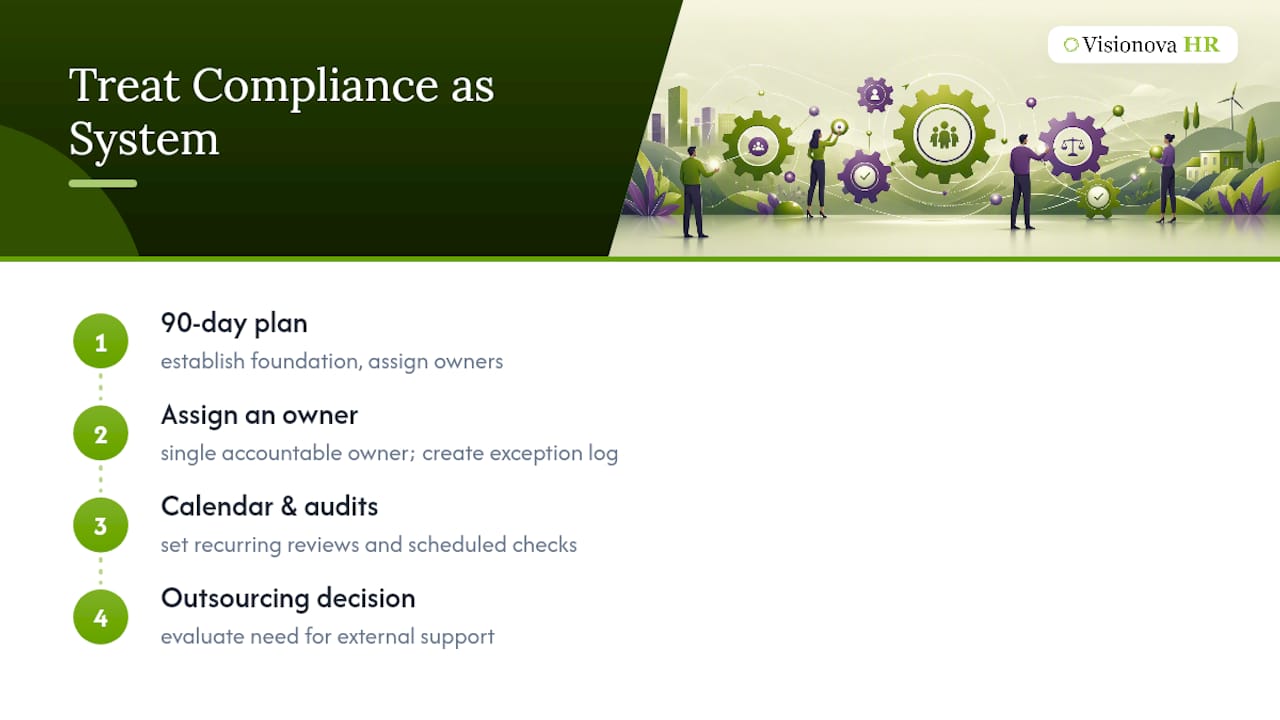
I’ve seen the preventable version of this play out the same way repeatedly: a manager verbally promises time off that conflicts with written policy, nobody documents the exception, and eighteen months later it becomes evidence in a dispute neither side wanted. The fix was never complicated. It was a missing owner and a missing log.
Start with the 90-day plan. Everything else, the calendar, the audits, the outsourcing decision, gets easier once that foundation exists.
— Bernadette
Get Hands-On Support for Your Compliance Gaps
Visionova HR is the practical alternative to piecing together compliance advice from generic templates and outdated blog posts. Where a do-it-yourself checklist leaves you guessing whether your handbook actually matches current law, Visionova HR builds the system, the handbook, the audit, and the ongoing support, with specialized depth in California employment risk that generic HR platforms don’t carry.

Bernadette Jones, SHRM-SCP, has guided California small businesses and nonprofits through compliance, culture, and difficult people decisions.
Small organizations and nonprofits benefit most, especially those facing a high-risk termination, a first multi-state hire, or a handbook that hasn’t been touched in years. Visionova HR’s services include handbook packages, HR audits, monthly HR support, and detailed guidance for preparing high-risk terminations the right way. If you’d rather learn hands-on, start with The People Problem Triage™, our framework for sorting a people problem before you act. Either way, the next step is simple: reach out for an HR audit before your next compliance gap turns into a legal problem.
Sources
- Small business requirements — U.S. Equal Employment Opportunity Commission
- Employer responsibilities — Occupational Safety and Health Administration
- The People Problem Triage™
- US Department of Labor recovers more than $259M in back wages for workers in 2025 — U.S. Department of Labor, Wage and Hour Division
Recommended
Note: This article is for general informational purposes only and is not legal advice. Employment decisions depend on the facts, applicable law, and jurisdiction. Consult qualified employment counsel for guidance on your specific situation.