
Values-based hiring measures candidates against documented, observable behaviors tied to your organization’s stated values, not just their résumé skills. The payoff is retention: people who share your values before day one tend to stay longer and cause fewer of the culture fires that eat up a leader’s week. The method works when you translate value words into specific behaviors, build structured interviews around them, and score every candidate against the same rubric.
TL;DR:
- Values-based hiring relies on specific, observable behaviors linked to organizational values, which improves retention and reduces culture clashes.
- The process requires translating values into clear behaviors, structured interviews, consistent scoring rubrics, and calibration to ensure fairness and legal defensibility.
- Skills remain important for technical roles, but for positions with high autonomy or team influence, values consistency strongly predicts success and fit.
- Pilot programs on high-turnover roles and regular review of value-behavior mappings enhance accuracy and scalability over time.
- Proper documentation aligned with EEOC guidelines reduces legal risk by providing a defensible, transparent hiring process focused on job-related criteria.
Table of Contents
- What Values-Based Hiring Means for Small Teams
- Turning Value Words Into Behaviors You Can Actually Interview For
- A Step-by-Step Checklist to Build Values-Based Hiring Into Your Process
- Staying Legally Defensible: What UGESP and EEOC Guidance Actually Require
- Measuring Whether It’s Actually Working
- Ready-to-Use Scripts, Questions, and a Scoring Rubric
- Where Values-Based Hiring Usually Breaks Down
- How Visionova Helps You Build This Without Guessing
- A Few More Places to Look
- Sources
- FAQ
What Values-Based Hiring Means for Small Teams
I’ve sat across the table from a nonprofit executive director who hired a program manager with a stellar résumé and a fifteen-minute gut-feel interview. Eight months later, that hire was undermining team trust, missing deadlines, and quietly discouraging collaboration. Nothing on paper predicted it. Nobody had asked the one question that mattered: does this person’s actual behavior match what we say we value?
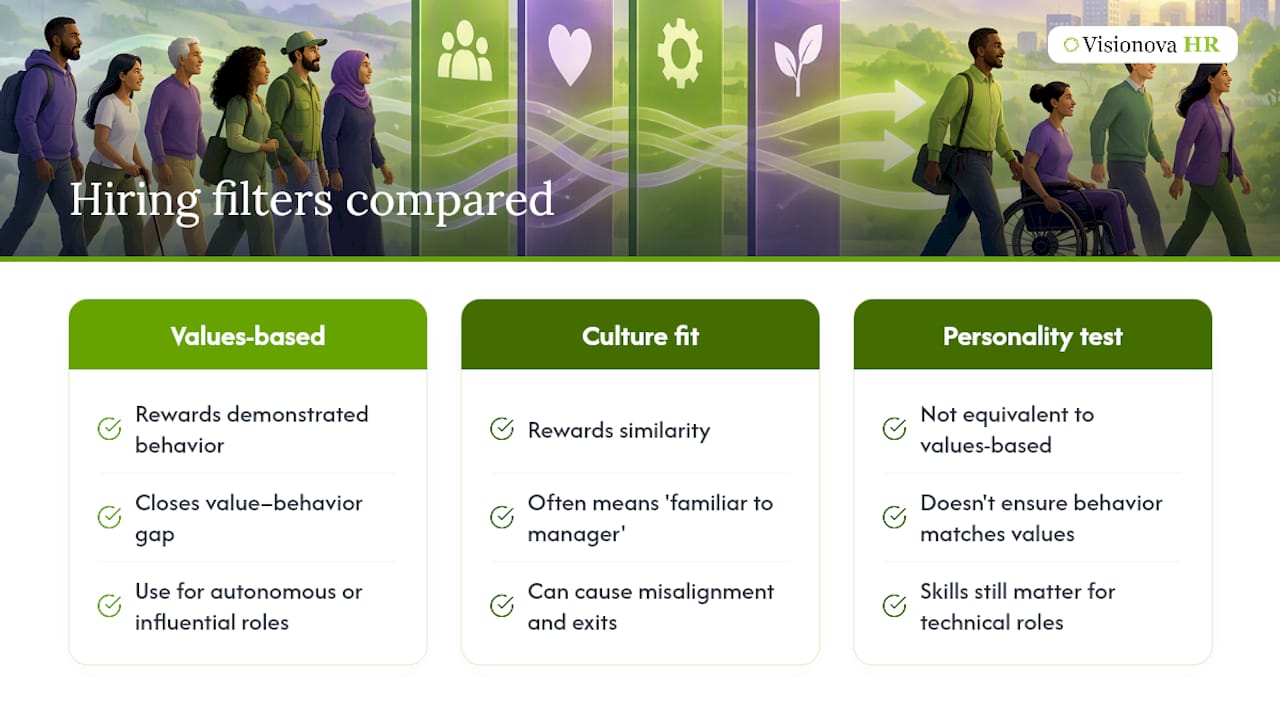
That’s the gap values-based hiring closes. It’s not a personality test, and it’s not “culture fit,” which too often means “someone who feels familiar to the hiring manager.” Culture fit hiring rewards similarity. Values based hiring rewards demonstrated behavior, which is a very different filter.
For organizations with 10 to 150 employees and no HR department, this distinction carries real weight. A Forbes report on values-based hiring found that most employees say they would not stay with an employer whose values clash with their own, and that misalignment is a common trigger for voluntary exits. In a 20-person company, one values mismatch in a leadership role can severely affect the whole team’s morale for months. Large companies absorb a bad hire. You usually can’t.
That doesn’t mean skills stop mattering. A surgeon needs technical precision regardless of how well they articulate your values in an interview. The rule of thumb: weight values heavily for roles with high autonomy, customer contact, or team influence, and weight skills more heavily for narrow, highly technical roles where the work itself is the safeguard.
Turning Value Words Into Behaviors You Can Actually Interview For
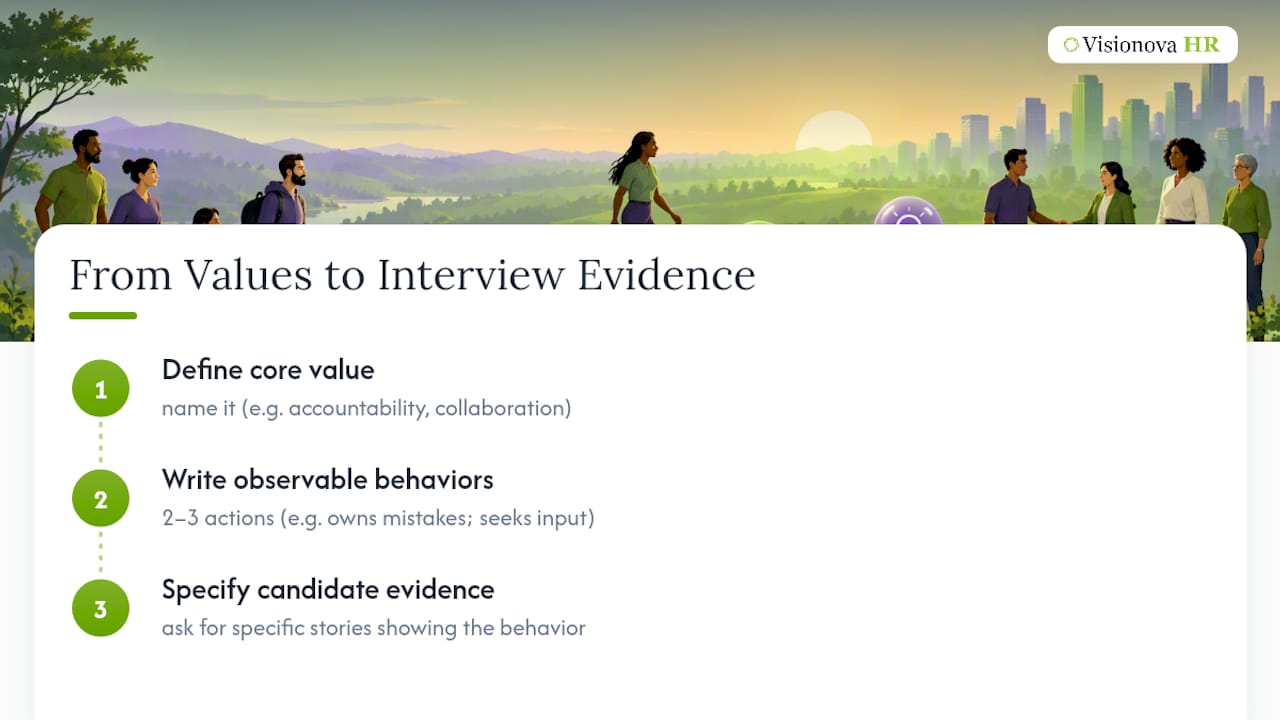
“Integrity” and “collaboration” sound good on a wall poster and mean nothing in an interview room unless you define what they look like in action. This is the step most organizations skip, and it’s the one that makes everything downstream work or fail.
The method is simple: take each core value, write two or three observable behaviors that demonstrate it, and decide what evidence a candidate could give you to prove it happened. For “accountability,” a behavior might be “owns mistakes without deflecting,” with evidence being a specific story where the candidate caused a problem and what they did next. For “collaboration,” a behavior could be “seeks input before deciding,” with evidence being an example of a decision they changed after hearing another view.
Common-role examples: a front-line supervisor might be assessed on “gives direct feedback respectfully,” while a development director might be assessed on “builds trust with donors under pressure.” Keep it to three or four values per role. Trying to assess seven values in a 45-minute interview produces shallow answers and exhausted interviewers.
A Step-by-Step Checklist to Build Values-Based Hiring Into Your Process
You don’t need a full HR department to run this well. You need a documented process and interviewers who follow it the same way every time.
- Confirm your values are leadership-endorsed and known. If your executive team can’t agree on what “excellence” means in practice, candidates never will either.
- Rewrite job descriptions with role-specific behaviors, not just duties and qualifications.
- Build a structured interview guide with the same core behavioral questions for every candidate in that role.
- Create a shared scoring rubric so two interviewers rating the same answer land in the same range.
- Add a work sample or situational exercise that forces the behavior to show up live, not just get described.
- Run a calibrated debrief where interviewers share scores before opinions, then discuss gaps.
- Set a decision rule in advance (e.g., no offer below a 3 average on any core value) so debriefs don’t drift into gut calls.
Common threads across practitioner guidance, including the BuiltIn framework for values-based hiring, point to the same sequence: identify the behavior, build the question, standardize the score.
- Pilot with one open role before rolling this out company-wide.
- Train interviewers on the rubric in a single 45-minute session, not a memo nobody reads.
- Revisit your value-behavior map annually; roles and teams change.
Pro Tip: Run your first pilot on the role you’re most likely to hire for again in the next twelve months. You’ll refine the rubric on a low-stakes cycle before it’s protecting a decision that really matters.
Staying Legally Defensible: What UGESP and EEOC Guidance Actually Require
A structured, values-based process isn’t just better hiring. It’s also your best legal protection, and that matters more than most small employers realize until they’re facing a complaint.
The Uniform Guidelines on Employee Selection Procedures, interpreted through EEOC guidance, require that any selection procedure be job-related and checked for adverse impact against protected groups. The commonly cited 4/5ths rule is a practical screen: if one group’s selection rate falls below 80% of the highest-scoring group’s rate, you need to look closer.
Here’s the part small employers miss: an unstructured “gut feel” interview is actually higher legal risk than a documented one, because there’s no consistent standard to defend if challenged. The Office of Personnel Management’s guide to structured interviews recommends identical questions, standardized rating scales, and a documented job analysis behind every hiring decision.
Practical steps that protect you:
- Base every interview question on an actual job analysis, not assumptions about the role.
- Keep interview notes and scored rubrics on file for every candidate, not just the one hired.
- Apply consistent questions and rubrics uniformly to candidates for the same role to maintain fairness and defensibility.
- Bring in outside validation help if a role affects a large applicant pool or shows a pattern of skewed outcomes.
If you’re unsure whether your interview process would hold up under scrutiny, a documentation review before a legal challenge is far cheaper than one after. Our guide on defensible termination documentation covers the recordkeeping habits that carry through the entire employee lifecycle, hiring included.
Measuring Whether It’s Actually Working
Values-based hiring is only worth the effort if you can show it moves a number. Track these from day one so you have a baseline before you scale the process.
- Retention at 90, 180, and 365 days for hires made under the new process versus your historical average.
- Voluntary turnover rate by role and by hiring manager.
- Candidate experience scores from a short post-interview survey.
- Adverse impact ratios across demographic groups, checked at least quarterly.
- Time-to-hire and scoring variance between interviewers, which flags calibration drift early.
Run it as a phased pilot: apply the new process to one role or one department, keep hiring for a comparable role the old way, and compare 180-day retention between the two groups. That paired comparison isolates the effect far better than a company-wide rollout you can’t untangle from other changes.
Candidate reactions matter here too. Research on procedural justice in selection, summarized in SIOP’s candidate experience whitepaper, shows that consistency and feedback during the process shape whether candidates view your organization as fair, which affects both your employer brand and litigation exposure.
Ready-to-Use Scripts, Questions, and a Scoring Rubric
You can start this Monday with three tools: behavioral questions, a rubric, and a work-sample brief.
Sample behavioral questions by value:
- Accountability: “Tell me about a time you made a mistake that affected your team. What did you do next?”
- Collaboration: “Describe a decision you changed after hearing someone else’s perspective.”
- Respect: “Tell me about a disagreement with a coworker you handled without damaging the relationship.”
- Initiative: “Walk me through a problem you solved before anyone asked you to.”
A simple 1 to 5 rubric works well: 1 means no evidence of the behavior, 3 means a clear but modest example, 5 means a specific, detailed story with a measurable outcome. Score before discussing as a group.
- Ask the behavioral question.
- Probe once for a specific example if the answer is vague.
- Score independently on the rubric.
- Compare scores in a calibrated debrief before deciding.
For reference checks, ask: “Can you describe a time this person demonstrated [specific value] under pressure?” For a low-cost work sample, give candidates a short, realistic scenario tied to your top value, such as a two-paragraph email conflict to resolve, and see how they handle it.
Pro Tip: Score the work sample before you read the résumé attached to it. It keeps the behavior, not the pedigree, driving the decision.
Where Values-Based Hiring Usually Breaks Down
Three mistakes account for most failed rollouts I’ve seen: values defined in abstract adjectives nobody can observe, interviewers who never received training on the rubric, and skipped calibration debriefs that let old gut instincts creep back in.
When a client asks me whether a hiring problem is really a values problem, I run it through a version of our People Problem Triage™ framework: Is this a skills gap, a values mismatch, or a management failure to set expectations? Those three questions, asked before you write a single job posting, save you from solving the wrong problem.
Your first step isn’t a new interview guide. It’s writing down, in behavioral terms, what your top three values actually look like in someone’s daily work.
— Bernadette
How Visionova Helps You Build This Without Guessing
If you’re staring at a blank interview guide wondering where to start, you don’t have to build this alone or from scratch. Visionova’s Compliance and Culture Roadmap gives you a structured path from vague values to a working, legally sound interview process, built for organizations without an in-house HR team to lean on. For leaders ready to go further, the Visionova HR Accelerator™ pairs rubric design with interviewer training and a pilot rollout, so your first hiring cycle under the new process is coached, not improvised.
A typical engagement includes delivering a finished scoring rubric, a short interviewer training session, and a one-role pilot to measure before scaling company-wide. If you’re not sure whether your current hiring gaps are a values problem, a management problem, or something else entirely, start with our People Problem Triage™ diagnostic to get clarity before you spend another hour rewriting job descriptions.
A Few More Places to Look
For deeper detail, the OPM structured interview guide and EEOC’s Uniform Guidelines Q&A cover the legal mechanics in plain terms worth bookmarking.
Sources
- Structured interviews: a practical guide (OPM)
- Questions and answers to clarify the Uniform Guidelines (EEOC)
- Values-Based Hiring: Look Beyond Skills To Find The Best Employees For Your Business (Forbes)
- Candidate experience and selection systems (SIOP whitepaper)
FAQ
What Is Value-Based Recruitment?
Value-based recruitment is a hiring approach that evaluates candidates against documented organizational values translated into observable, role-specific behaviors, rather than relying on general impressions of personality or background. It typically uses structured interview questions and a shared scoring rubric so every candidate is assessed the same way.
What Is the 70/30 Rule in Hiring?
Some SMB leaders reverse that ratio for high-autonomy or customer-facing roles, where values-related behaviors predict long-term success more than technical background alone.
What Is Values-Based Interviewing?
Values-based interviewing uses behavioral or situational questions tied directly to an organization’s stated values, asking candidates for specific past examples rather than hypothetical answers. Interviewers score responses against a consistent rubric, which improves reliability compared to unstructured, gut-feel conversations, according to OPM’s structured interview guidance.
What Are the 5 C’s of Hiring?
Definitions of the “5 C’s” vary across sources, and there’s no single standardized framework tied to values-based hiring specifically. Rather than force-fitting an unverified acronym, focus on what the evidence actually supports: documented values, behavioral translation, structured interviews, scoring rubrics, and calibrated debriefs.
Does Visionovahr Help Small Organizations Set Up Values-Based Hiring?
Yes. Visionova’s Compliance and Culture Roadmap and Visionova HR Accelerator™ are built specifically for organizations without an in-house HR team that need a rubric, interviewer training, and a pilot rollout. Current pricing and package details are listed on the Visionova solutions page.
Recommended
Note: This article is for general informational purposes only and is not legal advice. Employment decisions depend on your specific facts, applicable law, and jurisdiction, and California and local rules change often. Consult Visionova HR or qualified employment counsel before acting on your situation.