
Usually: treat the report as a triage level event. If it alleges discrimination, harassment, retaliation, or a safety risk, plan a prompt, documented investigation. In the meantime, listen and record what you heard, protect confidentiality and physical safety, and pause any discipline until triage is complete. These three moves buy you time to think clearly instead of reacting.
TL;DR:
- Protected activity includes opposing discrimination, joining an investigation, requesting an accommodation, or discussing pay; it remains protected even if the underlying complaint lacks merit.
- A yes on protected class, recurrence, or safety criteria usually calls for formal investigation; respond to urgent safety or active discrimination allegations within 24 to 72 hours.
- For routine interpersonal friction with no legal flag, gather facts over 7 to 14 days; two or more yes answers on triage criteria call for investigation.
- Use a neutral investigator, and hire an outside professional if the complaint names an owner, senior manager, or someone who supervises the investigator.
- Document the first conversation that day, preserve relevant messages and schedules, restrict file access, monitor retaliation, and postpone discipline until the investigation reaches a determination.
Table of Contents
- What Counts as a Workplace Complaint or Protected Activity
- People Problem Triage™: Deciding Whether to Coach, Mediate, Investigate, or Escalate
- Running a Defensible, Objective Investigation Step by Step
- Documentation and Communication That Hold Up Later
- Immediate Manager Mistakes to Avoid in the First 48 Hours
- Three Case Examples: Intake to Triage to Outcome
- When to Escalate to HR, Outside Investigators, or Employment Counsel
- People Problem Triage™ in Practice: A Printable Manager Checklist
- How Visionova HR Consulting Can Help You Move Forward
- FAQ
- Sources
- Essential EEOC and Visionova Resources to Consult Next
What Counts as a Workplace Complaint or Protected Activity
Not every frustrated comment is a complaint, but more statements qualify than most managers assume. A complaint is any report, written or verbal, that something happened that violates policy, law, or basic fairness. Protected activity is narrower and carries legal weight: it includes opposing discrimination, participating in an investigation, requesting a disability accommodation, or discussing pay with coworkers. The EEOC’s retaliation guidance makes clear that these actions are protected even when the underlying complaint turns out to lack merit, and taking materially adverse action against someone for engaging in them is unlawful.
Certain words should catch your attention immediately: “harassed,” “discriminated against,” “retaliated against,” or “I’m going to file a charge.” These phrases signal that an employee understands the situation in legal terms, whether or not they use the terms correctly.
When a report lands on your desk, a short intake conversation tells you what you’re dealing with:
- Who is involved, including witnesses who saw or heard something relevant.
- When the incident or pattern occurred, and whether it is ongoing.
- What exactly was said or done, in the employee’s own words.
- What documents exist: texts, emails, schedules, or performance notes.
That short list determines everything that follows.
People Problem Triage™: Deciding Whether to Coach, Mediate, Investigate, or Escalate
Once you have the basic facts, you need a fast way to sort the report into a track. We built People Problem Triage™ for exactly this moment, when a small employer has no HR department and needs a clear decision in minutes, not days.
Run the report against these criteria:
- Severity. Is there alleged harm, physical risk, or conduct that would embarrass the organization publicly?
- Protected class implication. Does the report touch race, sex, age, disability, religion, or another protected category, or reference retaliation for a prior complaint?
- Pattern or recurrence. Has this employee or this behavior come up before?
- Safety or criminal conduct. Does the report describe threats, violence, theft, or substance use on the job?
- Operational impact. Is the complaint disrupting a team, a client relationship, or daily operations?
A “yes” on criteria two, three, or four typically means you are past coaching and into formal investigation territory. Urgent matters, those involving safety or an active protected class allegation, deserve a response within 24 to 72 hours. Routine interpersonal friction with no legal flag can usually move on a 7 to 14 day timeline while you gather facts calmly.
Red flags that should trigger an automatic escalation to formal investigation include any mention of unwanted touching, slurs, a supervisor demanding something in exchange for a benefit, or a threat of violence.
Pro Tip: Write down which triage criteria applied to a report the moment you make the call. That single sentence of reasoning is often what protects you later.
Running a Defensible, Objective Investigation Step by Step
The person who investigates matters as much as the process itself. Whoever leads the inquiry needs enough distance from the parties to be seen as neutral. If the complaint involves an owner, a senior manager, or someone with authority over the investigator, bring in an outside investigator instead of handling it internally.
The EEOC’s employer checklists outline what a credible process looks like: a neutral investigator, a timely response, documentation from the first contact forward, privacy protections, and a written factual determination at the end.
A workable sequence looks like this:
- Preserve evidence immediately: lock down relevant emails, messages, schedules, or video before memories or records fade.
- Plan interview order, usually starting with the complainant, then the accused, then witnesses.
- Ask the same core questions of each person to keep the process consistent and fair.
- Document every interview in writing, close in time to when it happened.
- Weigh credibility using objective factors: consistency, corroboration, motive, and demeanor, not gut feeling alone.
- Write a short factual report stating what happened, your determination, and any corrective steps.
One documented step at a time is the whole discipline here. The checklists also recommend building in a way to check whether reporters or witnesses face retaliation while the investigation is still open, along with the authority to sanction anyone who retaliates. Keep the circle of people who know about the complaint as small as operationally possible, and hold off on any discipline against either party until you reach a determination.
A fractional legal perspective on internal investigation steps offers a useful cross-check if you want a second framework before deciding whether outside counsel needs to be involved.
Documentation and Communication That Hold Up Later
Good documentation starts at the first conversation, not after you decide the complaint is serious.
- Write a time-stamped file note the same day you hear the report, in your own words.
- Save copies of any texts, emails, or screenshots the employee shares.
- Record witness names before memories shift.
- Note any immediate safety steps you took, like separating schedules.
Store investigation files separately from general personnel files, limit access to people who need it, and keep a simple log of who viewed or added to the file.
For scripts: tell the complainant you will look into it and keep them reasonably informed, tell the accused what is being reviewed without assuming guilt, and remind witnesses the conversation is confidential to the extent possible.
Pro Tip: A due diligence checklist like this one for investigators shows you exactly what an outside investigator will ask for, so your files are ready before you need them.
Immediate Manager Mistakes to Avoid in the First 48 Hours
The first two days after a complaint are where most damage gets done, usually by well-meaning managers trying to smooth things over.
- Don’t promise absolute confidentiality. You can promise discretion, not secrecy.
- Don’t talk a serious allegation down into informal coaching to avoid paperwork.
- Don’t discipline either party before the facts are gathered.
- Don’t discuss the complaint with coworkers who have no role in resolving it.
Reactive moves that look harmless, like suddenly cutting someone’s hours or excluding them from a meeting right after they complain, often read as retaliation to an investigator or a court. A safer response in the moment: “I hear you, I’m taking this seriously, and I’ll follow up by [specific date].”
Three Case Examples: Intake to Triage to Outcome
Seeing the framework applied makes the decision easier the next time.
- Low-risk interpersonal friction. Two coworkers clash over scheduling and tone in meetings. Triage shows no protected class issue, no safety concern, no pattern. A manager coaches both employees and writes a brief file note. No formal investigation needed.
- Harassment allegation. An employee reports repeated comments about their appearance from a supervisor. Triage flags protected class and recurrence, triggering a formal investigation, interviews with witnesses, and a written determination that leads to corrective action against the supervisor.
- Retaliation risk from timing. An employee files a complaint, then is moved to a less desirable shift two days later. Even if unrelated, the timing creates retaliation exposure. The employer documents a legitimate, pre-existing business reason for the change or reverses it to remove the appearance of retaliation.
When to Escalate to HR, Outside Investigators, or Employment Counsel
Some reports are beyond what an owner or operations leader should handle alone.
- Any allegation touching a protected class, like race, sex, disability, or age.
- Any report involving potential criminal conduct or physical safety.
- Any complaint naming the CEO, owner, or another person with outsized authority.
- Any situation where retaliation is already suspected.
- Any case involving multiple parties or high reputational stakes.
Before you call HR support or counsel, gather a simple timeline, the documents you already have, a witness list, and a record of any prior actions taken against either party. Sharing facts candidly, rather than filtering them to look better, is what preserves privilege and trust with whoever you bring in.
People Problem Triage™ in Practice: A Printable Manager Checklist
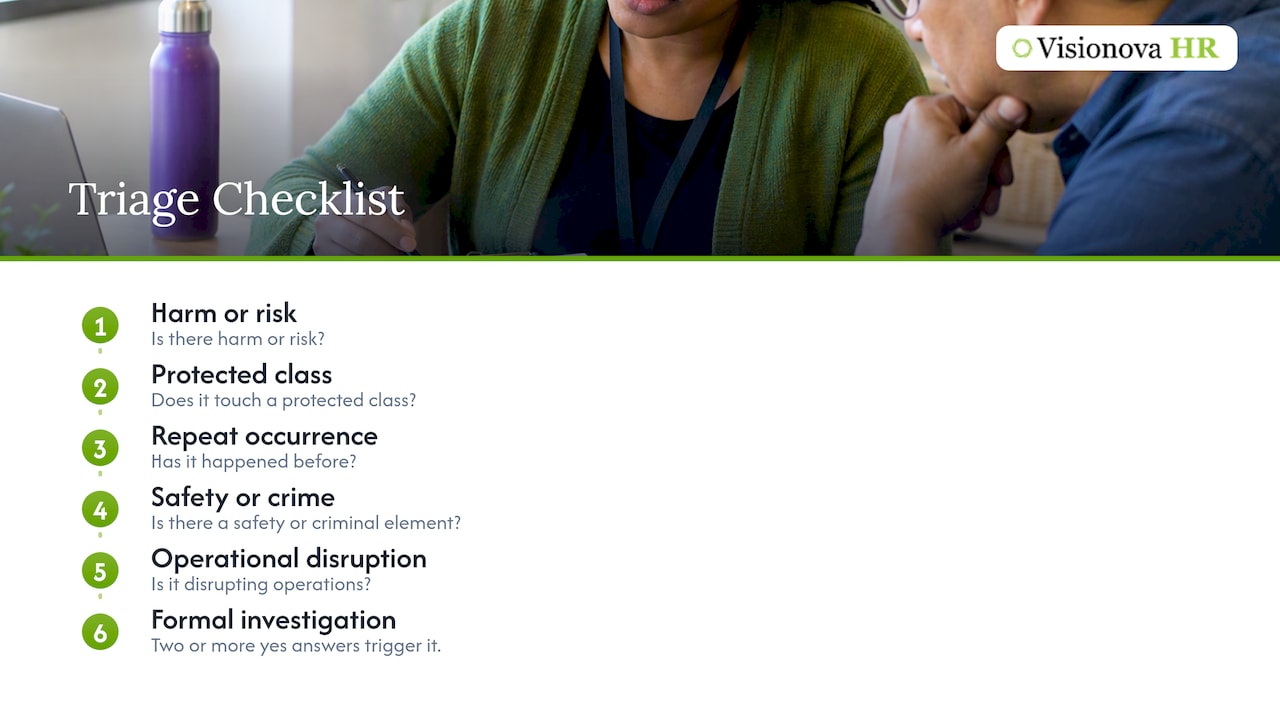
Print this and keep it near your desk. When a complaint comes in, ask: Is there harm or risk? Does it touch a protected class? Has it happened before? Is there a safety or criminal element? Is it disrupting operations? Two or more “yes” answers mean you move to formal investigation, not informal coaching.
In our work with small employers, the mistake we see most often isn’t malice. It’s hesitation that lets a fixable problem harden into a legal one. In the next 24 hours: write your file note, name a neutral person to handle intake, and hold off on any discipline until you have facts.
How Visionova HR Consulting Can Help You Move Forward
We built our On-Demand Human Resource Help and Compliance & Culture Roadmap for exactly this moment: a complaint lands, and you need an experienced second set of eyes without hiring a full HR department. We support California employers through intake review, investigation guidance, and the documentation that protects both your people and your organization. A typical next step is a short intake call where we help you triage the report and decide what happens next. If you’re facing a complaint right now, reach out through our Compliance and Culture Roadmap to talk through your situation.
FAQ
How do I effectively handle a disgruntled employee?
Listen fully before responding, write down what was said, and separate venting from an actual policy or legal complaint. If the concern touches a protected class, safety, or retaliation, move to a documented investigation rather than informal reassurance.
What are some examples of bad working conditions?
Common examples include unsafe physical environments, chronic understaffing that creates unsafe pressure, discriminatory treatment, and supervisors who retaliate against employees who raise concerns. Each of these can turn an informal complaint into a legal risk if left undocumented.
What are some factors that can hinder performance at work?
Unclear expectations, unresolved conflict with a manager or coworker, inconsistent feedback, and unaddressed harassment or discrimination all commonly hinder performance. Many of these surface first as informal complaints before they show up in productivity numbers.
What does “workplace concerns” mean?
Workplace concerns cover anything an employee raises about conditions, treatment, or conduct at work, ranging from minor interpersonal friction to serious allegations like harassment or retaliation. The EEOC’s small business guidance notes that prompt, documented responses to these concerns reduce the risk of retaliation claims regardless of how the underlying concern is ultimately resolved.
Essential EEOC and Visionova Resources to Consult Next
For deeper reading, review the EEOC’s retaliation and checklist guidance above, along with our high-risk terminations guide and HR audit checklist.
— Bernadette
Recommended
- Avoid Costly Leave Errors: CFRA vs FMLA Playbook for California Employers
- California Religious Accommodation: Manager Checklist and Scripts
- Workplace Conflict Mediation: 20 Minute Triage for California Managers
- Small Business HR Compliance: A Practical Action Plan
Note: This article is for general informational purposes only and is not legal advice. Employment decisions depend on your specific facts, applicable law, and jurisdiction, and California and local rules change often. Consult Visionova HR or qualified employment counsel before acting on your situation.