
Mediation is usually the fastest, relationship-preserving way to resolve workplace disputes when both people are still willing to talk. Start with a private triage and intake meeting this week; not a group sit-down. If either person is unwilling, unsafe, or the issue involves harassment or a legal violation, skip mediation and move straight to a formal HR process.
TL;DR:
- Mediation is most effective when both employees are willing, the relationship matters, and the dispute involves personality or communication issues rather than factual guilt.
- Serious harassment, threats, or criminal conduct require formal investigations, not mediation, to mitigate legal risks and ensure proper handling.
- The process involves separate triage meetings, interest-based joint sessions, and written agreements with clear actions and review dates to ensure durable resolutions.
- Managers should use the T·R·I·A·G·E framework to assess risk, clarify issues, and take one concrete step quickly, especially before formal complaints arise.
- External mediators are often safer for conflicts involving managers’ direct reports, while internal mediators can be effective if neutrality is maintained and trust is established.
Table of Contents
- What Is Workplace Conflict Mediation, and Why Does It Work?
- When Should You Use Mediation, and When Should You Not?
- How Does the Mediation Process Actually Work?
- What’s the Manager’s Role? The People Problem T·R·I·A·G·E Framework
- Scripts and a Documentation Checklist You Can Use Today
- How I’ve Seen T·R·I·A·G·E Change an Outcome
- Get a Clear Read on Your Situation
- Where to Read More on This Topic
- Sources
What Is Workplace Conflict Mediation, and Why Does It Work?
Workplace mediation is a voluntary, confidential process where a neutral third party helps two employees reach an agreement they both actually accept, rather than one imposed on them by a manager or an HR ruling. Nobody wins or loses. The CIPD’s mediation factsheet describes it as flexible and informal, generally binding on trust rather than on paper, which is exactly what makes it faster than a grievance process.
That informality is the point, not a weakness. A grievance investigation can take weeks and often leaves at least one person feeling punished. Mediation aims for something durable: a working relationship both people can live with.
The benefits show up in three places:
- It preserves the relationship instead of forcing one party to “win”
- It costs less in manager hours and legal exposure than a formal grievance or legal claim
- It produces written, forward-looking rules for how the two people will work together going forward
The evidence backs this up. Organizations that build mediation into a broader conflict management approach, rather than treating it as a one-time fix, report fewer formal grievances and better preserved working relationships than those relying only on formal procedures. Confidentiality has limits, though. If someone discloses harassment, retaliation, or a safety threat during mediation, you cannot keep that quiet. That gets reported and handled through your formal process, full stop.
When Should You Use Mediation, and When Should You Not?
Mediation fits certain conflicts and fails badly at others. Screen the case before you offer it.
- Both people are willing. Forced mediation rarely produces an honest conversation.
- The relationship still matters. If they need to keep working together, mediation is worth the investment.
- The issue is a personality clash, communication breakdown, or unresolved friction, not a factual dispute over what happened.
- Nobody needs a finding of right or wrong. ACAS is direct on this point: mediation is generally the wrong tool when a decision about guilt or innocence is required, such as criminal allegations or serious harassment.
- There’s no active safety risk or unaddressed power imbalance that would make one party unable to speak freely.
If any of those fail, stop and escalate. Serious harassment, threats, theft, or anything touching potential criminal conduct belongs in a documented investigation, not a mediation room. If you’re staring down a situation that could end in termination, understand the legal exposure first.
Internal mediators (you, or a trained peer) know the culture and cost nothing extra, but employees may doubt their neutrality. External mediators cost more and take longer to schedule, but nobody questions whose side they’re on. For anything involving a manager’s own direct reports, external is usually the safer call.
How Does the Mediation Process Actually Work?
Here’s the order that keeps mediation from turning into a shouting match with a facilitator in the room.
- Triage and intake. Meet each person separately first. Confirm they’re both willing, explain what’s confidential and what isn’t, and set the scope: this is about the working relationship, not a disciplinary hearing.
- Separate meetings. Ask each person what they actually need going forward, not just what happened. Negotiation research from Harvard’s Program on Negotiation shows that durable agreements come from uncovering underlying interests and managing emotion, not from re-litigating who’s right. Check for safety concerns and gather any documentation each person wants considered.
- Joint session. Set ground rules out loud: no interrupting, no character attacks, one person speaks at a time. Ask interest-based questions (“What would make this workable for you next month?”) instead of “what happened” questions that just restart the argument.
- Draft and sign the agreement. Write down who does what, by when. Vague promises don’t survive a bad week.
Some non-negotiables for that agreement:
- Specific, observable commitments, not general “communicate better” language
- A review date set in the near term
- A copy logged in your HR file, not just an email nobody can find later
Pro Tip: Frame every question around the future working relationship, not the past incident. “How do we make Tuesday’s team meeting work for both of you?” gets further than “Tell me what she did wrong.”
What’s the Manager’s Role? The People Problem T·R·I·A·G·E Framework
When two employees are stuck in tension and the manager keeps hoping it resolves itself, the situation doesn’t cool down. It calcifies. Here’s the framework I walk leaders through when that happens.
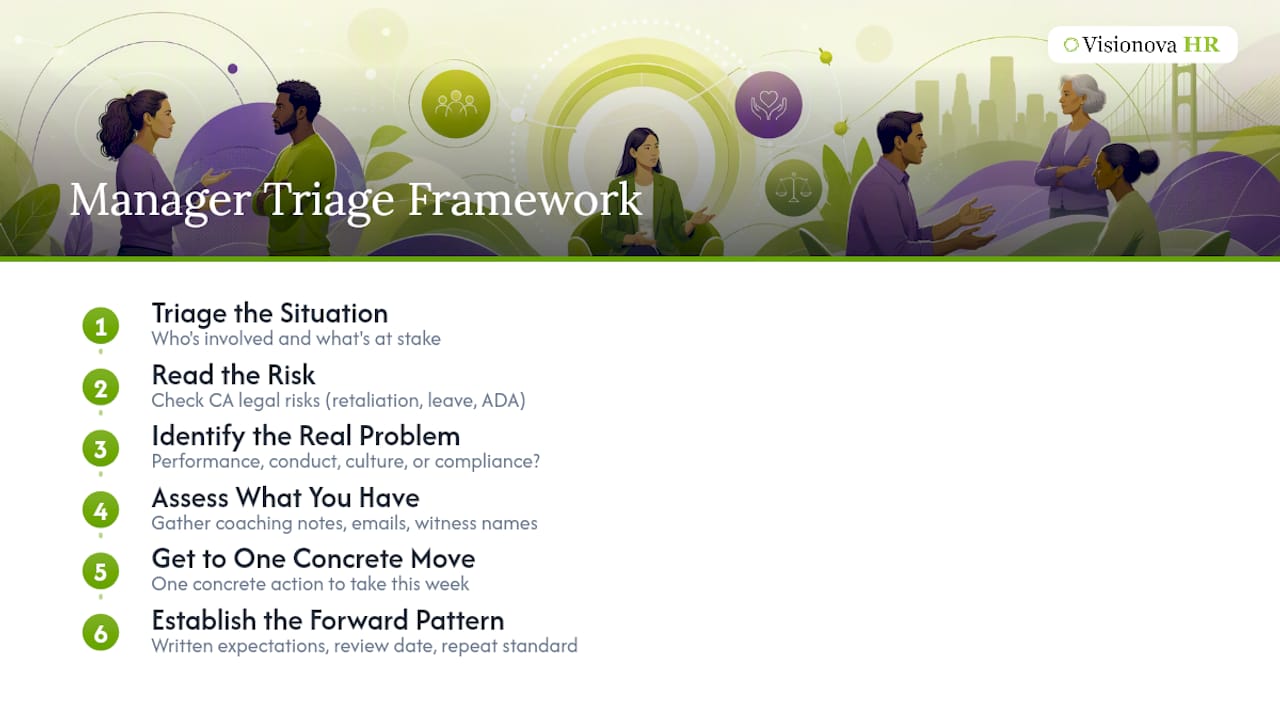
Triage the Situation. Who’s involved, and what’s actually at stake? A disagreement over meeting etiquette is not the same as one employee refusing to work with another.
Read the Risk. Ask whether this touches California law before you touch anything else. Is one person newly pregnant or on leave? Could this look like retaliation for a complaint filed last month? Does it involve a disability accommodation, or wage and hour friction like unpaid off-the-clock work? Under SB 294, California has expanded worker protections around retaliation reporting, and a conflict that looks purely personal can carry legal weight you don’t see at first glance.
Identify the Real Problem. Is this performance, conduct, culture, or a compliance issue wearing a personality-clash disguise? Mediation only makes sense for the first and last of those.
Assess What You Have. Pull prior coaching notes, emails, and witness names before you sit down with anyone. Early manager intervention works better precisely because it catches root causes before they turn into formal complaints, but only if you’ve actually looked at the history first.
Get to One Concrete Move. Not a five-point plan. One thing, done this week.
Establish the Forward Pattern. Written expectations, a review date, and a standard for what happens if the pattern repeats.
Pro Tip: If you’re not sure whether something is a legal risk, treat it like one until you’ve checked. It costs you an hour. Guessing wrong costs a lot more.
Scripts and a Documentation Checklist You Can Use Today
You don’t need perfect words. You need words that don’t make things worse.
Private intake script:
- “I want to understand what’s going on from your side, separately from anyone else.”
- “This conversation stays between us unless you tell me something I’m legally required to act on.”
- “What would need to change for this to feel workable?”
- “Are you willing to sit down with them if I facilitate it?”
Joint session opening:
- “We’re here to figure out how you two work together going forward, not to decide who was right.”
- “Everyone gets to finish a sentence before the other responds.”
- “Let’s focus on next month, not last month.”
Phrases to avoid, and why: Never say “I already know what happened” (it signals you’ve pre-judged), or “just get over it” (it tells the employee their concern doesn’t count), or “this stays off the record” when it legally can’t.
Informal verbal agreements are fragile. Anchor every resolution in writing, with a review date, because an unrecorded accord protects no one when memory gets fuzzy or the conflict resurfaces.
Documentation checklist for the file:
- Date and location of each meeting
- Names of participants and the mediator
- A short, factual summary, no editorializing
- Specific agreed actions with deadlines
- A scheduled follow-up date
How I’ve Seen T·R·I·A·G·E Change an Outcome
A nonprofit client had two program coordinators who’d stopped speaking directly, routing everything through a third teammate. The manager knew and hoped it would pass. It didn’t.
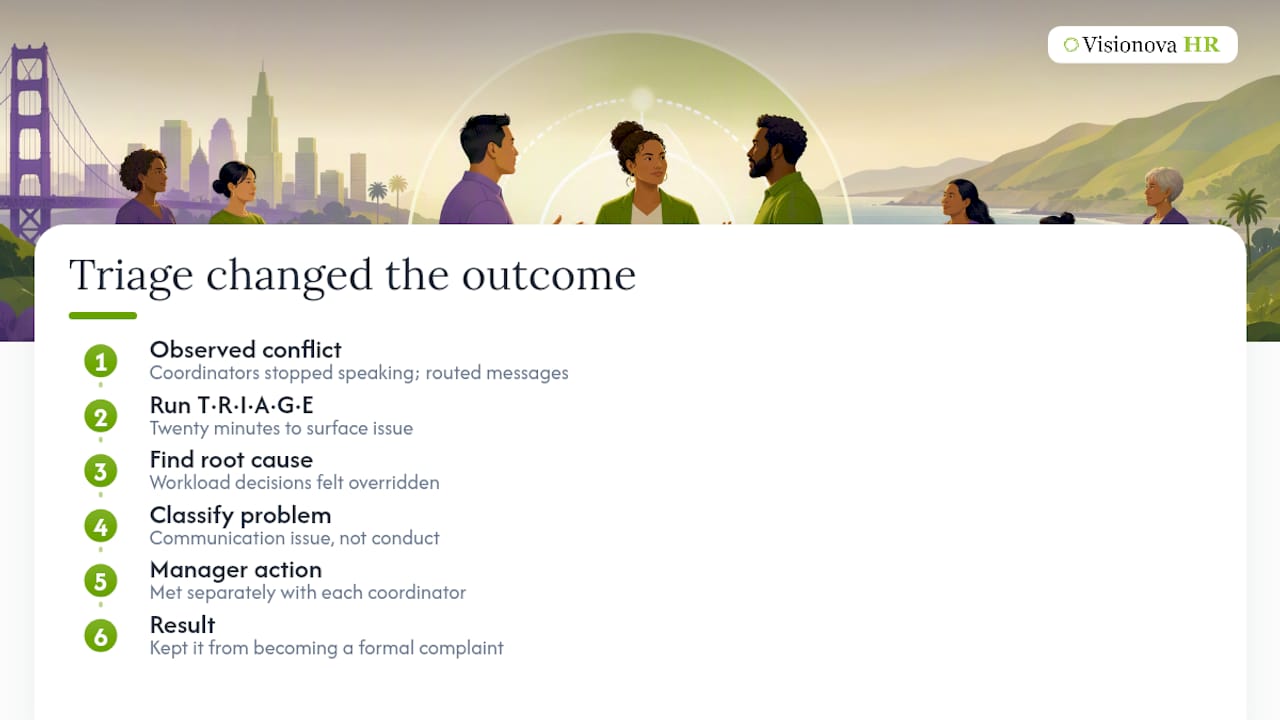
Running T·R·I·A·G·E surfaced the real issue in twenty minutes: one coordinator felt her workload decisions were constantly overridden without explanation, which read as disrespect, not disagreement. That’s a communication problem, not a conduct problem, so mediation fit. The one concrete move that week was small: the manager sat down with both, separately, before any joint conversation happened. That single step, done before anyone escalated, kept it from becoming a formal complaint.
If you’re sitting on a conflict like this right now, a short conversation can tell you which direction to go.
— Bernadette
Get a Clear Read on Your Situation
Visionovahr gives California small business and nonprofit leaders something a generic HR hotline can’t: a triage call with someone who actually knows California employment law and mediates workplace disputes for a living, not a script reader. Whether you need someone to facilitate a mediation session directly or just want a second opinion before you say the wrong thing to two upset employees, that’s the starting point.

On a first call, expect twenty minutes, no pitch, and a clear answer on whether this is a mediation situation, a documentation situation, or something bigger that needs formal legal guidance. If you’d rather build your team’s skills before the next conflict lands on your desk, our workshop programming covers conflict management directly. Book a free 20-minute People Problem Triage Call and find out where you actually stand.
This article provides general information and isn’t a substitute for advice from an employment attorney about your specific situation.
Where to Read More on This Topic
- ACAS — Mediation at work: screening criteria for when mediation fits.
- CIPD — Workplace conflict guide: manager-focused early intervention tactics.
- Program on Negotiation, Harvard: research on interest-based resolution.
- U.S. Department of the Interior: federal mediation program structure.
Sources
- CIPD — Mediation factsheet
- ACAS — Mediation at work
- Program on Negotiation (Harvard) — managing emotions in negotiation
Recommended
Note: This article is for general informational purposes only and is not legal advice. Employment decisions depend on the facts, applicable law, and jurisdiction. Consult qualified employment counsel for guidance on your specific situation.