
You’ve got a great employee.
They carry weight. They’re reliable. They’re the person you can hand something to and exhale.
And now you’re about to say something that can land like a demotion if you handle it with a lack of respect:
“Starting January 1, you’ll be hourly.”
Not because they did anything wrong.
Not because you value them less.
Because the compliance line moved, and you’re responsible for staying compliant and keeping your culture intact.
This is a leadership conversation with compliance consequences.
A moment you’ll recognize
One of the hardest versions of this conversation isn’t with your problem employee. It’s with your best one.
The one who takes pride in being “dependable.” The one who thinks salaried means, “They trust me.”
So when you say “hourly,” they may hear: “They don’t trust me anymore.” That’s not what you mean, of course, but that is what they may feel.
If you’re not ready for that emotional translation, you’ll speak like you’re reading a policy—and they’ll walk away feeling deflated and devalued.
California exempt salary threshold 2026: what changed (and why this is on you)
California’s exempt salary threshold increases when the state minimum wage increases. On January 1, 2026, that change creates the “$70K cliff” many employers are now dealing with. For official details, see the California Department of Industrial Relations announcement (December 2025).
If an employee is currently classified as exempt but does not meet the salary threshold, you generally have two practical options:
- Raise salary to keep the role exempt, or
- Reclassify to non-exempt (hourly)
Either way, this is not a “set it and forget it” admin task. It’s a leadership moment.
Why reclassification hits trust so fast (even when it’s “just compliance”)
When you reclassify someone, the employee often hears a story you didn’t intend:
“I’ve been demoted.”
“I’m not leadership anymore.”
“I’m not trusted.”
“This is the beginning of being pushed out.”
That’s why leaders start over-explaining. They try to “logic” the employee into feeling safe.
But safety doesn’t come from long explanations. It comes from clarity + dignity + follow-through.
Hold this steady:
Compliance and culture are twin guardrails. Ignore compliance and you create risk. Ignore culture and you create turnover, and you don’t always see it until your best people stop offering their best.
How to Reclassify Without the Mess
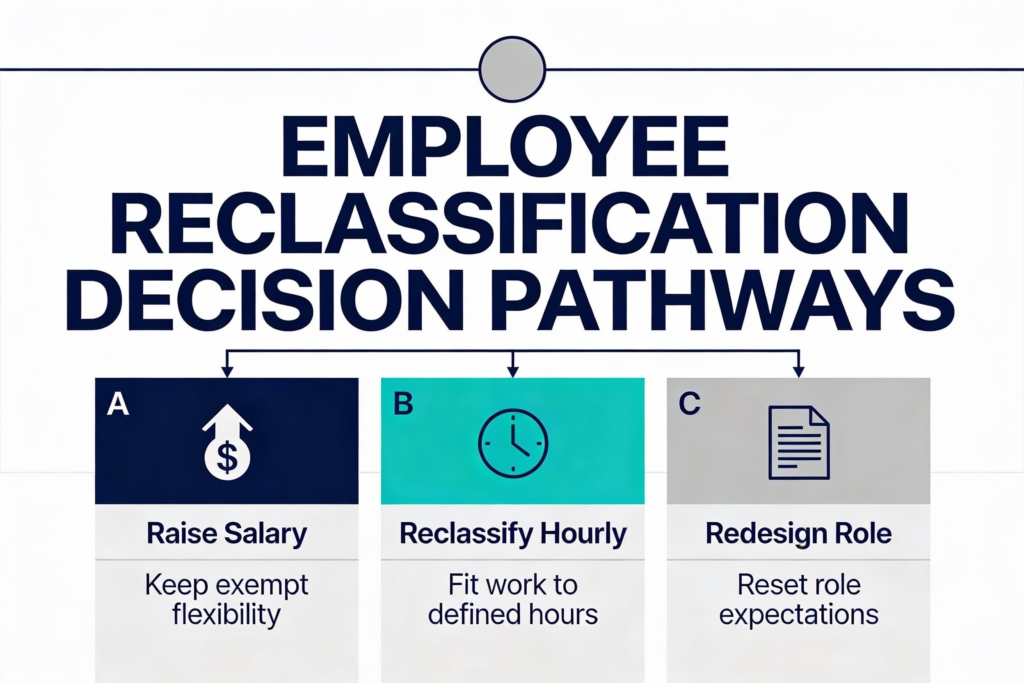
Before you speak, choose your lane. Don’t decide in the room.
Lane 1: Raise the salary and keep exempt
Best when the role truly needs exempt flexibility and the budget supports it.
Lane 2 B: Reclassify to hourly (non-exempt) with clear boundaries
Best when the work can fit into defined hours and you’re willing to manage priorities.
Lane 3: Redesign the role to match compensation and responsibility
Best when the role drifted into exempt expectations without exempt compensation.
If you choose hourly, you also choose this responsibility:
Reset expectations so the job fits the hours you’re paying for.
That’s what protects trust or breaks it.
What to say in the first 60 seconds
Your job in the conversation isn’t to teach wage law. Your job is to protect dignity while being clear.
Use this opener:
“I want to talk with you about a classification change that’s required as of January 1. This isn’t about your performance or your value here. Your role still matters. What’s changing is how we track time and how hours are paid.”
Then get practical, fast.
What changes (be plain, not vague)
Timekeeping: “You’ll track time in [SYSTEM].”
Schedule: “Your standard hours are [HOURS/DAYS].”
Overtime: “Overtime must be approved and paid—so we’re setting boundaries that protect your time.”
Workload: “We’re aligning priorities so the work fits inside paid hours.”
If you skip specifics, employees fill in the blanks. And blanks get filled with fear.
The mistake that breaks trust after reclassification (and creates overtime risk)
Here’s what kills it:
You reclassify them and then keep treating them like an exempt employee.
After-hours “quick questions.” Praise for “always available.” Meetings outside their schedule. Same workload, just a new label.
That’s when a great employee thinks: “So I’m hourly… but the job is still salaried.”
And that’s how you lose them.
If you reclassify but don’t reset expectations, you’re setting them up to fail, and creating overtime liability for yourself.
What to Do in Week 1 (So You Don’t Undo the Conversation)
- Stop texting after hours. If it’s urgent, call during work hours.
- Review the task list. Cut or defer anything that doesn’t fit paid hours.
- Train your managers: “Overtime must be approved” means you can’t praise someone for “going the extra mile” off the clock.
Toolbox (Free downloads — use these so you don’t wing it)
Reclassification Conversation Script Guide
After the Conversation Checklist
If you’re facing several exempt salary threshold changes at once, the biggest risk isn’t the change—it’s inconsistency. Different scripts, different boundaries, different manager behavior.
Book a Free 20-Minute Discovery Call and we’ll map the cleanest lane for each role and protect trust while you get compliant.
You don’t lose people because you got compliant. You lose people because it wasn’t handled well. Be clear. Be respectful. Then back it up with your actions.
Disclaimer
This article is general information and not legal advice. Classification rules depend on role duties, pay practices, and jurisdiction. For advice specific to your organization, consult qualified counsel.
Written by Bernadette Jones, SHRM-SCP | HR Expert Consulting | San Francisco | Oakland | Nationwide.
Visionova HR Berandette Jones has over 20 years of experience helping California and nationwide employers resolve high risk concerns, training, and coaching. Last updated January 12, 2026