
You had the conversation.
You stayed composed. You explained the change. You tried to say it with respect. They nodded, maybe even smiled, and you thought, “Okay. We got through it.”
After reclassifying an employee from exempt to hourly in California Here’s what most leaders don’t realize until it’s too late: The conversation is not the finish line. It’s the opening scene.
The next 30 days is where your employee decides what story they’re going to believe:
“They still respect me.” or “I need to protect myself.”
If you want them to stay engaged, your actions have to match your words.
This is the plan that makes that happen.
Why Trust Shifts Quietly
Reclassification hits three nerves at once:
Status: “Hourly feels like I moved down.”
Autonomy: “They’re going to watch me now.”
Belonging: “I’m not their person anymore.”
That doesn’t make your employee fragile. It makes them human.
So if you do nothing after the conversation, they’ll still do something: They’ll quietly adjust how much of themselves they give you.
The Rule Leaders Ignore
If you reclassify someone but keep expectations exactly the same, you’ve created a trap:
They either work extra and resent you, or they stop working extra, and you call it “attitude.”
Both routes break credibility.
The fix is simple and non-negotiable:
Reset the workload in writing. Not in your head. Not in a hallway. In writing.
California requires accurate timekeeping and recordkeeping for all non-exempt employees. Vague expectations create invisible labor pressure, and invisible labor pressure destroys culture.
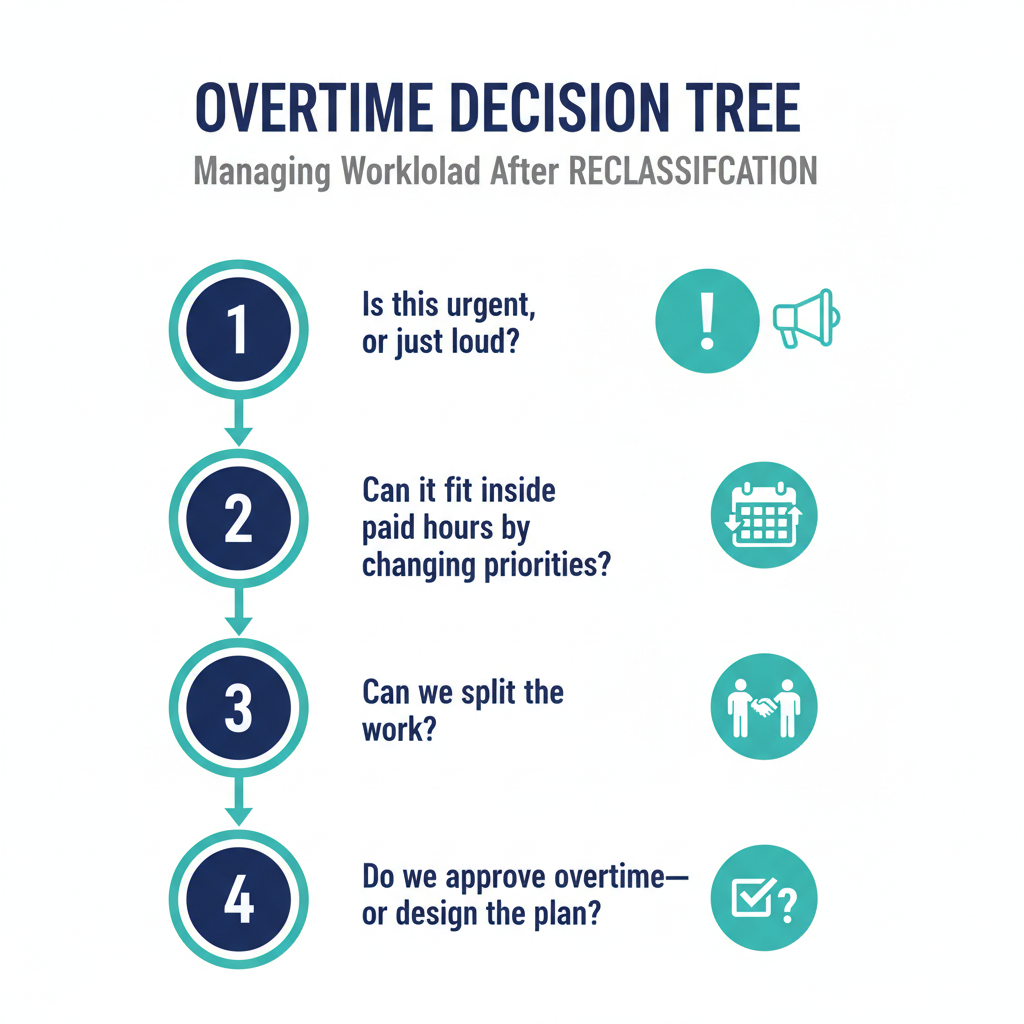
Overtime Decisions: A Simple Tree
Use this every time the work doesn’t fit the hours:
Step 1: Is this urgent, or just loud?
If it can wait 24 – 48 hours, schedule it. If it impacts payroll, safety, client delivery, or legal risk, keep going.
Step 2: Can it fit inside paid hours by changing priorities?
If yes, reprioritize, and name what gets paused.
Step 3: Can we split the work?
If yes, reassign pieces to others.
Step 4: Do we approve overtime?
If yes, approve it in writing and name the endpoint. If no, stop pretending and redesign the plan.
Here’s the line leaders need to live by: If you won’t approve overtime, you also don’t get to demand overtime. And remember, California law requires you to pay for all hours worked, even if overtime wasn’t pre-approved.
Week-One Guardrails for Reclassified Employees
1) Timekeeping must feel normal, not punitive
Train them. Confirm what counts as “work.” Make it clean.
2) Set a boundary for after-hours contact
Pick one standard and keep it:
“If I message after hours, it’s for tomorrow.”
“After-hours work must be approved and logged.”
“No after-hours contact unless urgent.”
3) Change what you praise
Stop praising “always available.” Start praising “clear priorities, clean execution, smart boundaries.”
4) Make meetings match the schedule
Don’t schedule outside their hours and call it “flexible.” You’re creating invisible labor—and that destroys the relationship.
The 30-Day Trust Cadence Tree
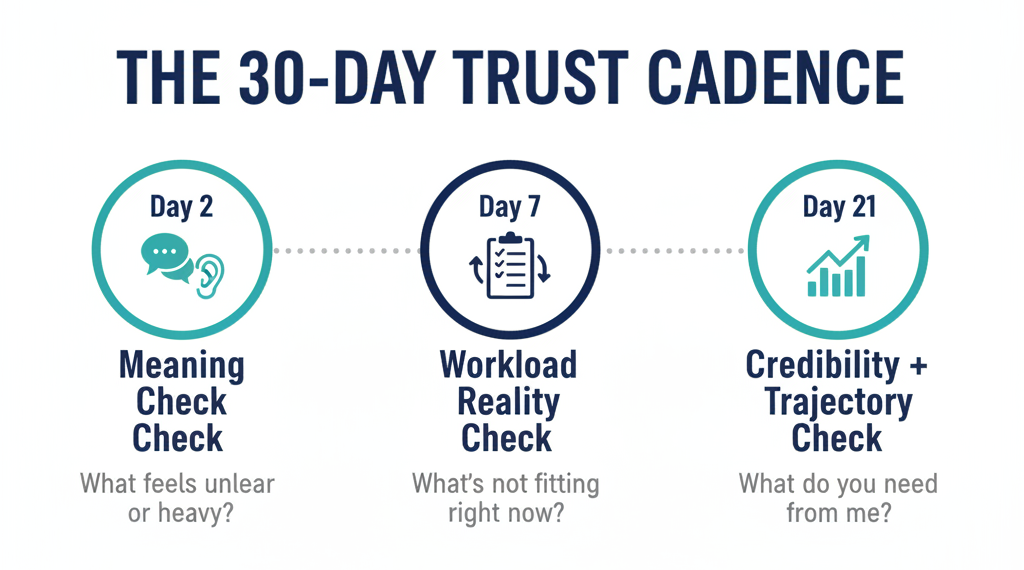
Day 2: Meaning Check
“I want to check in. I meant what I said—this wasn’t about your value here. What feels unclear or heavy since that conversation?”
Then stop.
What NOT to say: “How’s everything going?” (Too vague—doesn’t invite honesty.) “Let me know if you’re struggling.” (Puts the burden on them to speak up.)
Day 7: Workload Reality Check
“If we’re paying for defined hours, we need defined priorities. What’s not fitting right now?”
Then remove something. If you remove nothing, you’re just performing concern.
What NOT to say: “You seem stressed.” (Diagnoses instead of asks.) “Just let me know if it’s too much.” (Still puts the burden on them.)
Day 21: Credibility + Trajectory Check
“I care about your growth here. This change doesn’t take that off the table. What do you need from me so you still feel momentum in your role?”
That’s how you rebuild respect without lying.
Toolbox (Free downloads)
After the Conversation Checklist
Reclassification Conversation Script Guide
(Conversation Hub): How to Tell a Great Employee They’re Going Hourly (Without Breaking Trust)
Need help with multiple California reclassifications?
If you’re doing this across several roles, you need consistency. One sloppy manager can undo all your careful words.
Book a Free 20-Minute Discovery Call and we’ll map your lane per role and the 30-day follow-up plan so trust holds while you stay compliant.
Anchor close (kind + firm): Respect isn’t what you said in the meeting. Respect is what your employee experiences the next 30 days.
Disclaimer
This article is general information and not legal advice. Classification rules depend on role duties, pay practices, and jurisdiction. For advice specific to your organization, consult qualified counsel.
Written by Bernadette Jones, SHRM-SCP | HR Expert Consulting | San Francisco | Oakland | Nationwide.
Visionova HR Berandette Jones has over 20 years of experience helping California and nationwide employers resolve high risk concerns, training, and coaching. Last updated January 12, 2026